Plant listing · Baddi, Solan, Himachal Pradesh
WHO Certified Pharma Plant for Sale in Baddi, Himachal Pradesh
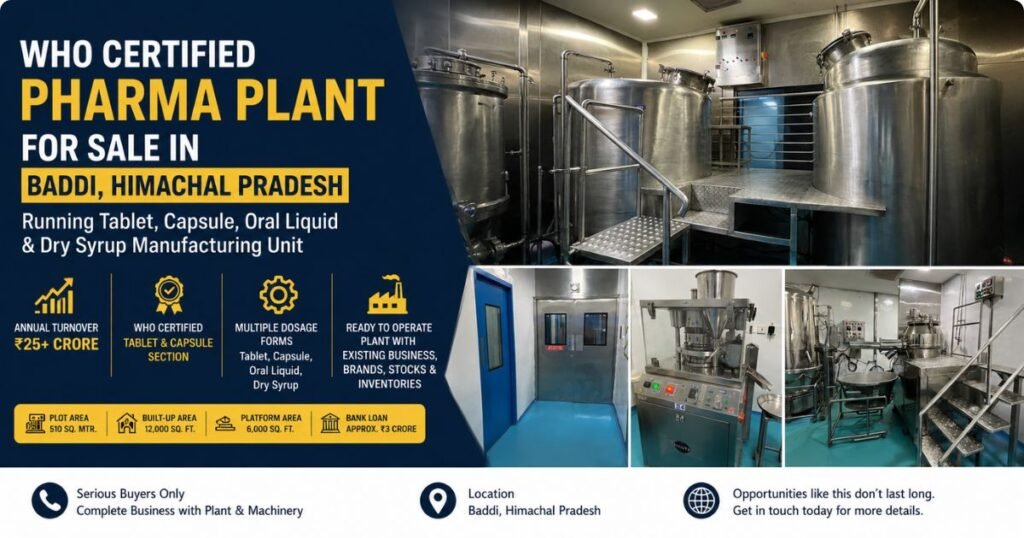
A running formulation unit in the BBN belt with tablet, capsule, oral liquid and dry syrup sections, WHO-GMP scope on tablets and capsules, annual turnover stated at over ₹25 crore, and an asking price of ₹15 crore including business, brands and inventories.
At a glance
Facility overview
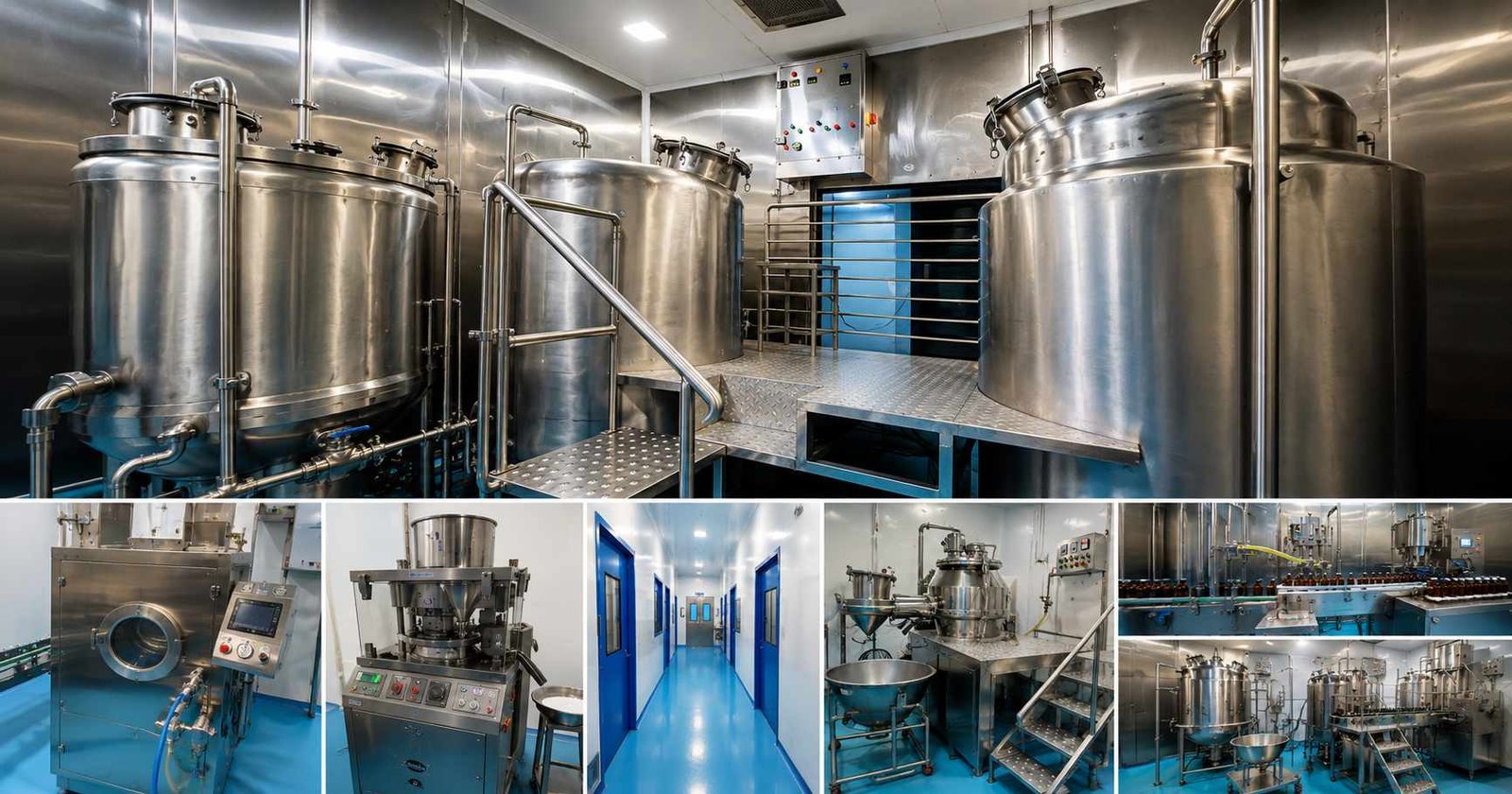
This is a compact, operational formulation unit in Baddi, Solan district, Himachal Pradesh, offered as a going concern. The transaction is structured to include the business, marketed brands, finished goods and inventories rather than land and building alone, which is what separates it from a bare asset sale.
| Parameter | Details |
|---|---|
| Location | Baddi, Tehsil Nalagarh, District Solan, Himachal Pradesh · PIN 173205 |
| Industrial belt | Baddi–Barotiwala–Nalagarh (BBN) cluster |
| Plot area | 510 square metres (approximately 5,490 sq. ft.) |
| RCC built-up area | Approximately 12,000 sq. ft. |
| Additional platform area | Approximately 6,000 sq. ft. — definition to be confirmed with the seller |
| Manufacturing sections | Tablets, capsules, oral liquids, dry syrups |
| WHO-GMP scope | Tablet and capsule sections only — oral liquid and dry syrup sections are not stated to be covered |
| Annual turnover | ₹25 crore and above (seller-stated, unaudited) |
| EBITDA or net profit | Not disclosed |
| Bank liability | Approximately ₹3 crore — treatment at closing not disclosed |
| Asking price | ₹15 crore (an indicative transaction range of ₹13–15 crore has also been cited) |
| Included in the transaction | Business, brands, inventories, finished goods, stocks and manufacturing assets |
| Year of construction | Not disclosed |
| Revised Schedule M status | Not disclosed — mandatory for all manufacturers from 1 January 2026 |
Location
Why Baddi still commands a premium
Baddi is an industrial town and municipal council in the south-western corner of Solan district, sitting at roughly 426 metres on the Himachal–Haryana border in the Shivalik foothills. It anchors the Baddi–Barotiwala–Nalagarh belt, which grew into one of India’s densest formulation clusters after the 2003 industrial package. The practical value to a buyer is not the address, it is the ecosystem: packaging converters, excipient stockists, contract testing laboratories, engineering and HVAC contractors, and a workforce that has already worked inside GMP areas.
Connectivity
Road, rail and air links
- Chandigarh: approximately 35–45 km by road depending on route, broadly one to one and a half hours.
- Nearest airport: Chandigarh International Airport (Mohali), roughly 45 km.
- Nearest railway: Kalka is around 28–30 km; Chandigarh junction is around 45–50 km.
- Nalagarh: about 15 km · Barotiwala: about 5 km · Solan: about 35–40 km · Shimla: about 110 km.
- Codes: PIN 173205 · STD 01795 · vehicle registration series HP-12 (Nalagarh).
Administration
Who regulates this site
Land and development matters in the belt run through the Baddi–Barotiwala–Nalagarh Development Authority (BBNDA), while drug licensing and inspection sit with the Drugs Control Administration, Himachal Pradesh, under the State Drugs Controller. CDSCO’s Baddi office was upgraded from sub-zonal to zonal status in 2023, which means central inspection and COPP processing capacity for the northern states now sits locally.
- Tehsil Nalagarh · District Solan
- Assembly constituency: Doon · Lok Sabha: Shimla
- Verify licence status, endorsed products and inspection history directly with the state licensing authority before signing.
Compliance
Certification and regulatory status
This is the part of the listing that carries the most value and the most ambiguity. Read the two cards below together, then read the correction underneath them before you put a number on the certification.
What WHO-GMP actually is
Certificate, scope and paperwork
The World Health Organization does not certify factories. In India a WHO-GMP certificate is issued by the State Licensing Authority after a joint inspection against Schedule M and the WHO GMP main principles.3 The Certificate of Pharmaceutical Product (COPP), which is the document an importing regulator actually asks for, is issued in the WHO-recommended format through CDSCO and is typically valid for two years; since July 2025 applications run exclusively through the ONDLS portal.4
So “WHO certified” here should be read as: the tablet and capsule sections hold a WHO-GMP certificate. Ask for the certificate itself, the sections and product list it covers, the issuing authority, and the issue and expiry dates. A certificate that has lapsed, or that covers three products rather than thirty, is a very different asset.
Revised Schedule M
The 2026 question you cannot skip
Revised Schedule M was notified on 28 December 2023. Small and medium manufacturers below ₹250 crore turnover could apply in Form A to the Central Licence Approving Authority for an extension to 31 December 2025.1 That window has closed. CDSCO directed state controllers to inspect extension applicants from an effective date of 1 January 2026, and the revised standard now applies to every manufacturer with no relaxations remaining.2
At ₹25 crore turnover this unit falls squarely in the MSME bracket the extension was written for. Three documents settle it: the Form A upgradation plan that was filed, the evidence of completion, and the most recent risk-based inspection report. If those do not exist, price the upgrade into your offer.
Honest correction on the headline: “WHO certified” describes a WHO-GMP certificate held for the tablet and capsule sections only. On the information disclosed, the oral liquid and dry syrup sections are not covered. That matters commercially — you cannot obtain a COPP for a product made in a section that sits outside the certified scope, so half the dosage-form capability in this plant is, as things stand, domestic-market capability. Extending WHO-GMP scope to the liquid and dry syrup sections is possible but costs time, capex and a fresh inspection.
Second correction, on enforcement climate: Himachal Pradesh has been repeatedly over-represented in CDSCO’s monthly not-of-standard-quality alerts, and the state Drugs Control Administration has taken action against dozens of firms in the belt over the past two years. That is a sector-level fact about the region, not an allegation against this unit. It does mean the NSQ and drug-alert history of this specific licence is a mandatory diligence item, not an optional one.
Decision support
Due diligence score
Scored conservatively on disclosed information only. A low score signals missing evidence, not a proven weakness — several of these should move up sharply once the seller opens the data room.
Overall, disclosed information only
14 of 25 points. Financials, the WHO-GMP certificate and Schedule M evidence are the three documents that move this number most.
Before you sign
Buyer checklist
Tick items as you clear them. Nothing is stored or transmitted — the list resets when you reload the page.
Checklist progress
0 of 14 items cleared
Numbers
Investment snapshot
Turnover has been disclosed here, which is more than most listings offer. Profitability has not, and profitability is what determines payback. Everything below is marked for what it is.
Indicative payback model
Test the deal against your own numbers
Every field is editable. Outputs come from what you type, not from seller data. Work in lakh throughout — 100 lakh equals ₹1 crore.
Read this before using the numbers: the ₹25 crore turnover, the ₹15 crore ask, the ₹3 crore liability and the WHO-GMP claim are seller-provided and unaudited. The calculator works only on figures you enter. It ignores interest, depreciation, tax, stamp duty, transfer costs and goodwill amortisation, and it is not a valuation, forecast or financial advice. Have a chartered accountant and a lawyer run the real numbers before you commit.
Data quality
Five points that need clarification
- The price is stated two ways. A ₹15 crore asking price sits alongside an indicative transaction value of ₹13–15 crore. Add an undefined ₹3 crore bank liability and the real enterprise value ranges from ₹13 crore to ₹18 crore — a spread of nearly 40 per cent. Resolve the price and the debt treatment in the same conversation, in writing, before anything else.
- “WHO certified” needs a scope. The certification is stated for tablets and capsules. Oral liquids and dry syrups appear to sit outside it. Ask which sections and which products the certificate names, who issued it, and when it expires. Also ask whether any COPP is currently live, because a COPP is what an importing regulator actually reads.
- The geometry does not add up on one floor. 510 square metres is about 5,490 sq. ft. of plot. Twelve thousand sq. ft. of RCC construction on that footprint means at least two and realistically three levels, at close to full ground coverage. That is workable, but multi-level pharma buildings raise material flow, personnel flow and segregation questions under Revised Schedule M. Get the approved plan and the floor-wise layout. Separately, ask what “6,000 sq. ft. additional platform area” actually is — a covered mezzanine, an open shed, or a hard-standing yard are three very different assets.
- Turnover is not profit. ₹25 crore of sales tells you the plant runs. It tells you nothing about what it earns. A unit at 4 per cent EBITDA and a unit at 14 per cent EBITDA on the same turnover are separated by roughly a decade of payback. Ask for three years of audited financials and the segment split between own brands and third-party job work.
- Revised Schedule M compliance is now binary. Since 1 January 2026 there is no extension window left for any turnover bracket. Either this unit completed its upgradation and can show the paperwork, or it did not — in which case the capex to close the gap is your cost, and any adverse inspection outcome is your problem from day one. Do not accept a verbal assurance on this one.
If you are weighing this against building from scratch, run the comparison through the pharma plant setup cost calculator. If the plan is to load the plant with your own marketing network, see how PCD and propaganda-cum-distribution models work in practice. Buyers who want a smaller entry point should compare this against the cGMP unit at Tahliwal, Una at ₹6.5 crore, and anyone who needs sterile capacity should look at injectable manufacturing instead, which this plant is not equipped for. Before a site visit, review the SOP framework you will be auditing against and the expectations set out in FDA guidance on high-purity water systems. If regulated-market export is the eventual plan, benchmark current systems against WHO-GMP and USFDA expectations.
FAQs
Questions buyers ask about this unit
Request the WHO-GMP certificate, licences and financials
Send an enquiry and we will share the available documents, the machinery list and the financial position, and arrange a site visit at Baddi. Independent verification and professional due diligence are recommended before any commitment.
More listings and advisory: browse pharma plants for sale or contact Laafon Galaxy Pharmaceuticals.
References
- Ministry of Health and Family Welfare, Government of India. Drugs (Amendment) Rules, 2025 — G.S.R. 127(E) dated 11 February 2025, inserting a proviso allowing small and medium manufacturers below ₹250 crore turnover to apply in Form A to the Central Licence Approving Authority for extension of the Revised Schedule M implementation timeline to 31 December 2025.
- Central Drugs Standard Control Organisation. Directive of the Drugs Controller General of India dated 7 November 2025 to state licensing authorities to plan inspections of units that applied for the Revised Schedule M extension, with an effective implementation date of 1 January 2026.
- World Health Organization. WHO good manufacturing practices for pharmaceutical products: main principles. WHO Technical Report Series.
- Central Drugs Standard Control Organisation. WHO-GMP certification and Certificate of Pharmaceutical Product (COPP) under the WHO Certification Scheme; applications processed through the Online National Drugs Licensing System (ONDLS) portal.
- Ministry of Health and Family Welfare, Government of India. Schedule M, Drugs and Cosmetics Rules, 1945 — Good Manufacturing Practices and Requirements of Premises, Plant and Equipment for Pharmaceutical Products, as revised by G.S.R. 922(E) dated 28 December 2023.
Listing details, areas, capacities, certifications, turnover, liabilities, inclusions, availability and commercial figures are supplied by the seller for enquiry purposes and must be independently verified. Regulatory status, certificate scope and validity are subject to confirmation with the issuing authority. Laafon Galaxy Pharmaceuticals acts as an introducer and does not warrant seller-supplied information. This content is not legal, regulatory, investment or financial advice.