Confidential listing · Himachal Pradesh · Full sale
The short answer
A running GMP pharmaceutical formulation unit at Sansarpur Terrace Growth Centre, Tehsil Jaswan, district Kangra, Himachal Pradesh is offered for full sale at an asking price of approximately INR 10 crore. The plant manufactures oral solid dosage forms (tablets and capsules), oral liquids, external preparations and dry-powder sachets under State manufacturing licences in Form 25 and Form 28.
The building was constructed between 2020 and 2022 across four levels — basement warehouse, ground-floor manufacturing and packing, a first-floor quality control laboratory with instrument, chemical and microbiology sections, and a second-floor water system. Declared total plot area is about 3,582 sq m with about 3,918.75 sq m of built-up area across the four levels.
The two questions that decide this deal in 2026: where the unit actually stands against the revised Schedule M — the seller has completed a gap assessment and filed an upgradation plan, and site work is visible in the photographs below — and whether you acquire the company, so the licences survive, or only the assets, which means fresh licences. Both are addressed on this page.
Listing prepared by Laafon Galaxy Pharmaceuticals · Published 10 September 2026
- Asking price~ INR 10 Cr
- Constructed2020–2022
- Plot area~3,582 sq m
- Built-up (4 levels)~3,918.75 sq m
- LicencesForm 25 & 28
- StatusRunning
How to read the figures on this page. Every area, section, utility and licence detail below is declared by the seller and reproduced here as supplied. Laafon Galaxy has not independently measured the premises, inspected the equipment or verified the licence record with the Drugs Control Licensing Authority, Himachal Pradesh. Treat this page as the basis for a site visit and a document check, not as a substitute for either. Where the information memorandum is silent — and on this unit the equipment list and shift capacities are silent — this page says so plainly rather than filling the gap with an estimate.
The facility
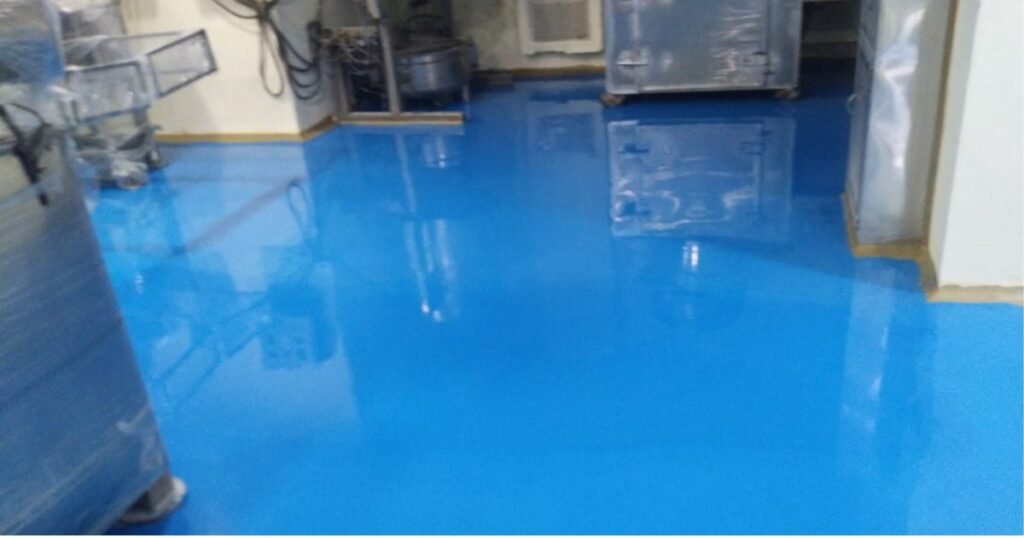
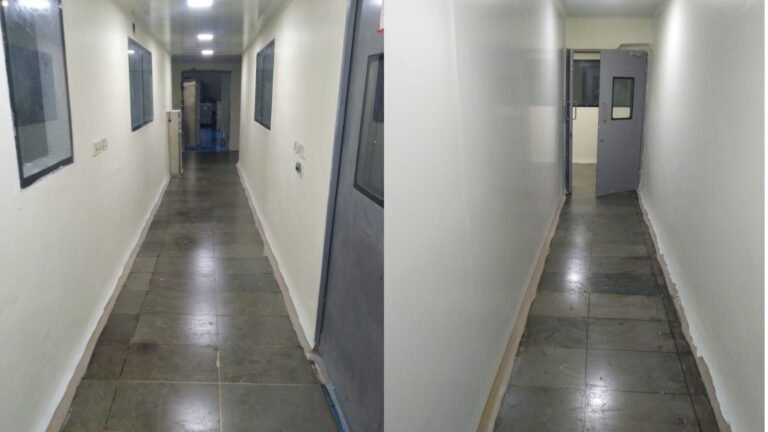
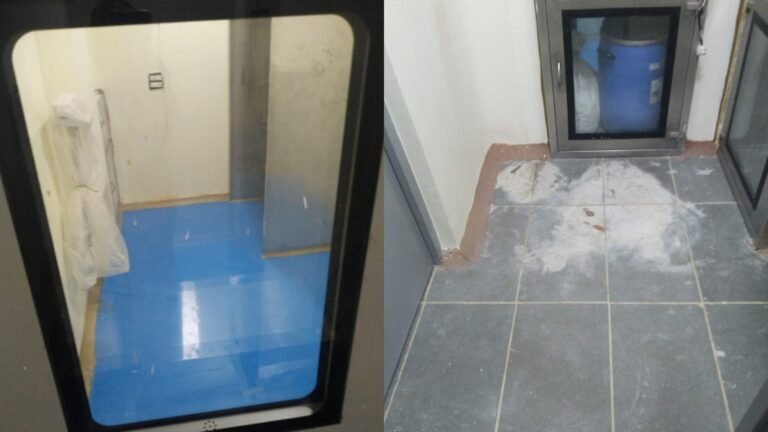
Photographs supplied by the seller, taken during the current facility upgradation programme. Select any image to enlarge it.
-
General manufacturing hallSeamless epoxy flooring laid wall to wall with coved skirting; process equipment sheeted during the works. -
Production corridorInspection windows into each room, flush doors, walkable false ceiling and recessed lighting. -
Airlock and change roomEpoxy application in progress, with pass box, flush doors and masked skirting line. -
Packing sectionStrip or blister machine in position, return air riser and finished floor. -
Granulation and drying areaProcess vessel, tray dryers or hot-air ovens, control panels and material trolleys.
What the photographs actually evidence, and what they do not. They evidence seamless flooring with coved wall-to-floor junctions, flush doors, inspection windows and a walkable ceiling — the physical fabric that revised Schedule M expects of a clean area, and the part of an upgradation that is expensive to retrofit. They do not evidence air handling performance, differential pressures, water quality or the documentation system. Those are established by qualification records and a live inspection, not by photographs. Ask for both.
What you are actually buying
Licences and regulatory position
The unit falls under the Drugs Control Licensing Authority, Himachal Pradesh, which administers the Drugs and Cosmetics Act, 1940 and the Rules made under it across the State through district Assistant Drug Controller offices, including the ADC office for Kangra [7].
Two manufacturing licences are declared, and they are not interchangeable [4]:
- Form 25 (issued under Rule 70) is the licence to manufacture for sale or distribution drugs other than those specified in Schedules C, C(1) and X. This is the licence that covers ordinary tablets, capsules, oral liquids, external preparations and dry-powder sachets.
- Form 28 (issued under Rule 76) is the licence to manufacture for sale or distribution drugs specified in Schedules C and C(1), excluding those in Schedule X.
The unit is running, with manufacturing and packing carried out under these licences. Licence numbers, copies, validity dates and the endorsed product permission lists are released after a mutual NDA.
Ask at diligence: request the product permission list endorsed on each of Form 25 and Form 28, not just the licence copies. That list, not the licence number, tells you what you may legally make on day one, and it determines how much of your intended portfolio needs fresh product permissions before it can be manufactured here. Reconcile it against the four approved sections — oral solid dosage, oral liquids, external preparations and sachets — and against the approved layout drawing.
Land, building and floor-wise layout
Declared total plot area is approximately 3,582 sq m (about 38,555 sq ft). Declared built-up area is approximately 3,918.75 sq m (about 42,180 sq ft) across four levels, which averages a little under 1,000 sq m per level and implies a comfortable ground coverage ratio with room on the plot for expansion, utilities and effluent handling. Construction was carried out between 2020 and 2022.
| Level | Declared use | What it constrains |
|---|---|---|
| Basement | Warehouse — raw material and packing material storage, and dispensing | Inventory depth, and whether dispensing is done in a qualified sampling and dispensing booth with its own air handling |
| Ground floor | Manufacturing and packing for all four sections; admin office; quality assurance | Line segregation and cross-contamination control between four dosage forms sharing one floor plate |
| First floor | Quality control laboratory — instrument, chemical and microbiology | Analytical throughput and in-house release capability; microbiology on site is a real asset, not a common one |
| Second floor | Water system | Distribution loop length and dead legs; sanitisation regime |
Scroll the table sideways on a phone.
The microbiology laboratory is worth pricing separately. A great many mid-size formulation units in the North India belt have an instrument and chemical laboratory but send microbiological testing outside. Revised Schedule M expects microbiological control of water, environment and non-sterile products to be demonstrated, not assumed. An on-site microbiology section already built and running removes a capex line, a recruitment problem and a turnaround-time bottleneck for the buyer. Verify that it is qualified and in routine use, with trend data, rather than merely constructed.
Reconcile the areas before you offer. The information memorandum gives level-wise uses but not room-wise areas. Ask for the approved building plan, the licence layout drawing and a room-wise area statement, and compare them against the published Schedule M area benchmarks. Four dosage forms on a single ground-floor plate is workable, but only if segregation, airlocks and dedicated air handling per section are demonstrated on the drawing and on site.
Approved sections
Four sections are declared as approved:
- Oral solid dosage — tablets and capsules.
- Oral liquids — syrups and suspensions.
- External preparations — creams, ointments, lotions and similar topicals.
- Sachets — dry powder.
Four approved sections on one licence is a wider footprint than most units of this size carry, and it is the main commercial argument for this asset. It lets a buyer place tablets, capsules, a syrup range, a topical range and an ORS or dry-powder sachet range through a single licensed entity, instead of splitting a portfolio across three contract manufacturers.
Capacity: not declared
The information memorandum for this unit does not state an equipment list or a per-shift capacity, and this page will not invent one. That is a gap to close at diligence, not a defect to assume. Ask the seller for: the machine-wise equipment list with make, model, year of installation and rated output for each section; three months of batch manufacturing records; and the achieved output per eight-hour shift computed from those records rather than from nameplate ratings. The gap between declared and achieved capacity is the single most common source of post-acquisition disappointment in Indian formulation deals, and here you have the advantage of starting from an honest blank rather than from an inflated number.
The specific machines to identify first, because they set the ceiling for each section: the compression machine and coating pan for tablets; the capsule filling machine; the liquid manufacturing tank volume and the filling line head count for oral liquids; the mixer batch size and tube or lotion filling speed for external preparations; and the auger filler and sealing speed for sachets.
Utilities and support systems, as declared
- Purified water: a purified water system serving capsules, liquids and other products, fed by a water treatment plant with softeners and filters on the incoming raw water, and reverse osmosis units in the purification train.
- HVAC: air handling maintaining clean room temperature, humidity and pressure differentials, with HEPA filtration.
- Compressed air: oil-free compressors serving pneumatic tools, air-operated valves and drying.
- Chilled water: chillers serving process vessels, HVAC and heat exchangers.
- Vacuum: vacuum pumps and systems for tablet compression, encapsulation and cleaning applications.
- Power: electrical supply with emergency backup.
Three utility items are not mentioned in the information memorandum. Raise all three in your first written request to the seller.
First, steam. No boiler is declared. Oral liquids, external preparations and equipment cleaning normally need a steam source, and a plant running four sections without one is unusual. Establish whether a boiler exists, its rating and fuel, and its Boiler Inspectorate registration — or whether the process design genuinely avoids steam.
Second, effluent treatment. No ETP is declared. An operating formulation unit generates equipment-wash effluent and needs consent to operate from the Himachal Pradesh State Pollution Control Board. Ask for the current consent to operate for air and water with expiry dates, and for the ETP capacity and discharge arrangement, whether an on-site plant or a common effluent facility within the growth centre.
Third, purified water performance. The purified water system is the item most often found wanting at a revised Schedule M inspection. Ask for the design, installation, operational and performance qualification package, plus at least twelve months of trend data on conductivity, total organic carbon and microbial counts. With a microbiology laboratory on site, that data should exist and should be easy for the seller to produce. If it does not exist, that tells you something important about the documentation system.
Revised Schedule M: in Kangra this is the whole conversation
Nowhere in India is the revised Schedule M question sharper than in this district, and any buyer looking at Sansarpur Terrace needs the cluster context before they look at the building.
The revised Schedule M was notified by the Ministry of Health and Family Welfare as G.S.R. 922(E) dated 28 December 2023 [1]. Manufacturers with annual turnover up to INR 250 crore were later given until 31 December 2025 to comply, provided they filed an upgradation plan with the Central Licence Approving Authority [2]. That window has closed, no further extension has been notified, and the Drugs Controller General of India directed State and Union Territory drug controllers in November 2025 to begin inspections against the revised standard and to file monthly reports on observations and enforcement action [3].
Himachal Pradesh felt this immediately. In October 2025 the Himachal Drug Manufacturers Association reported that only 122 of 655 firms in the State had complied with the revised standards, and sought a two-year extension to April 2027 [6]. In Kangra district specifically, nine pharmaceutical units shut operations — five of them at Sansarpur Terrace, out of what had been fifteen factories there, and four at Nurpur — with over 700 workers affected and six further units reported to be close to closure [5].
Read that as a buyer, not as a bystander. A cluster in which a third of the units at this growth centre have stopped is a cluster in which a unit that is still running, still licensed and actively upgrading is a scarce asset rather than a commodity one. It also means the trained operator pool, the maintenance contractors and the packaging vendors that support this belt are available, and that the competitive set a new entrant would face has thinned considerably. The same enforcement wave that closed nine units is what makes a compliant survivor worth acquiring rather than replicating.
The seller’s declared position on this unit is that a gap assessment against the revised Schedule M has been completed and an upgradation plan has been filed, with remediation work in progress. The facility photographs above show part of that programme — seamless flooring with coved junctions through the manufacturing areas and corridors.
Verify the plan, then price the remainder. Ask for four documents and read them in this order: the written gap assessment; the upgradation plan as filed, with its acknowledgement; the completion status against each line item in that plan; and the most recent inspection report from the Drugs Control Licensing Authority with its observations and closure evidence. Physical works — flooring, doors, ceilings, air handling — are the visible half. The other half is systems: a formal Pharmaceutical Quality System, Quality Risk Management, product quality review, complaint and recall handling, change control, qualification and validation, self-inspection and supplier audits [1]. Those cost competent people and time rather than concrete, and whatever remains open belongs in your offer price, not in your first year of operations.
You can run a first-pass readiness view against the same twelve inspection focus areas on the Revised Schedule M readiness checker, and compare the declared production areas against published Schedule M area benchmarks on our Schedule M plant area requirements guide.
What happens to the licences when the plant changes hands
Buyers routinely assume that a manufacturing licence transfers with the building. It does not. The licence attaches to the licensee, and the deal structure decides whether it survives.
Both the Form 25 and the Form 28 licence carry the same standard condition [4]:
“The licensee shall inform the Licensing Authority in writing in the event of any change in the constitution of the firm operating under the licence. Where any change in the constitution of the firm takes place, the current licence shall be deemed to be valid for a maximum period of three months from the date on which the change takes place unless, in the meantime, a fresh licence has been taken from the Licensing Authority in the name of the firm with the changed constitution.”
| Deal structure | What happens to Form 25 / 28 | Practical consequence |
|---|---|---|
| Share purchase (buy the company) | The licensee entity is unchanged, so the licence continues in the same name | Fastest route to production. Intimate the Licensing Authority in writing; the three-month clock applies to a change in constitution, so agree the filing plan before completion. You inherit every historical liability of the entity, including any open Schedule M observations. |
| Asset purchase (buy land, building, machinery) | The licence does not come with the assets. A fresh licence is required in the buyer entity name | Plan for a fresh application, inspection and grant, plus fresh product permissions. Production stops until grant — and in the current Himachal enforcement climate, a fresh grant is inspected against the revised standard from day one. Cleanest on liability, slowest on revenue. |
| Joint venture or majority stake | May amount to a change in constitution depending on the shareholding change | Get a written position from the Licensing Authority before signing, not after. Do not rely on the seller’s assurance. |
Scroll the table sideways on a phone.
The proposed transaction is a full sale of the operating unit with its land, building, plant and machinery, licences and documentation. Confirm in the term sheet which of the two routes that means, because on a running four-section unit the difference between them is measured in months of lost production and in whether the endorsed product permissions survive.
Which route into the Himachal belt actually fits you?
Buying a plant is one of four ways to manufacture in Himachal Pradesh, and it is not automatically the right one. Answer both rows.
1. What do you want out of Himachal Pradesh?
2. What can you commit?
Pick one option in each row
The verdict and the regulatory control point that governs it will appear here.
Routes referenced above: loan licence facilitation on a vetted host facility · third-party contract manufacturing · PCD franchise · all Himachal Pradesh listings.
Buy this unit, or build one?
The honest comparison is not price against price. It is price against time to first saleable batch, because a greenfield project spends its first eighteen to thirty months producing nothing while a licensed unit produces from the month after completion — and because a greenfield built today is inspected against the revised Schedule M from its first day, with no transition window available.
| Route | Capital | Time to first commercial batch | Licence position |
|---|---|---|---|
| Acquire this unit | ~INR 10 Cr asking | Weeks, if structured as a share purchase | Existing Form 25 and 28 continue with the entity, with four approved sections |
| Greenfield build | See our current cost bands | 18 to 30 months including licensing | Fresh application, inspection and grant, against the revised standard from day one |
| Loan licence | Working capital only | Typically a few months | Form 25A or 28A in your name, on a host facility |
| Third-party manufacturing | Working capital only | Weeks | None. The host manufactures on its own licence |
Scroll the table sideways on a phone.
Current greenfield capital bands by plant type, and where the money actually goes, are set out in our pharma manufacturing plant cost guide for 2026. If you want an indicative number for your own configuration, the plant setup cost calculator takes about two minutes. Run it before you negotiate: the replacement cost of a four-section unit on nearly 3,600 sq m of land, with a microbiology laboratory, is the number that tells you whether an asking price is a premium or a discount.
Location: the Sansarpur Terrace and Kangra pharma belt
Sansarpur Terrace Growth Centre sits in Tehsil Jaswan in the south-western corner of Kangra district, close to the Una district boundary, at the Kangra end of the Himachal Pradesh pharmaceutical corridor that runs up from Baddi through Una and Amb.
Practical connectivity for a buyer, indicative and to be confirmed on the site visit: the nearest broad-gauge railhead is Amb Andaura, a short road distance away on the Nangal–Una–Amb line; Chandigarh is roughly 175 km by road, which is the practical airport and corporate-travel reference point for this unit; and Kangra (Gaggal) airport is materially further, in the region of 100 to 120 km through the district.
What matters more than the kilometres is the three-part cluster argument. First, an established operator and technician pool: this is a pharmaceutical growth centre, not an isolated site, and the fifteen factories that have operated here trained the workforce you would otherwise import. Second, vendor depth — packaging converters, engineering contractors, calibration and analytical service providers — is already present across the Una, Amb and Baddi axis. Third, Himachal Pradesh remains one of India’s principal formulation manufacturing States, which is what keeps that vendor and labour ecosystem viable.
The counterweight, stated plainly. The same cluster is under real stress: nine units in this district stopped in 2025 and industry bodies have warned that several hundred small units across the State are at risk [5][6]. For a buyer with the capital and the quality systems to operate to the revised standard, that stress is the opportunity — it thins the competition and softens asset pricing across the belt. For a buyer who intends to run the unit the way it might have been run in 2019, it is a warning. Decide honestly which of the two you are before you make an offer.
Ten questions to put to this seller
Drawn from the specific claims and the specific silences in this listing, rather than from a generic template. Our full 50-point pharma plant acquisition checklist covers the rest of the diligence programme.
- Produce the revised Schedule M gap assessment, the upgradation plan as filed with its acknowledgement, and the line-by-line completion status against that plan.
- Share the last three inspection reports from the Drugs Control Licensing Authority, Himachal Pradesh, with observations and closure evidence.
- Provide the product permission list endorsed on each of Form 25 and Form 28, with current validity dates, not just the licence copies.
- Supply the machine-wise equipment list for all four sections, with make, model, year of installation and rated output — this is absent from the information memorandum.
- Give three months of batch manufacturing records so the achieved output per shift can be computed rather than declared.
- Confirm whether a steam boiler exists, its rating, fuel and Boiler Inspectorate registration.
- Produce the effluent treatment arrangement and the current consent to operate for air and water from the Himachal Pradesh State Pollution Control Board, with expiry dates.
- Produce the purified water system qualification package and twelve months of conductivity, total organic carbon and microbial trend data.
- Reconcile the level-wise areas against the approved building plan and the licence layout drawing, with a room-wise area statement.
- Confirm in writing whether the transaction is a share purchase or an asset purchase, the filing plan with the Licensing Authority, and which technical staff — particularly the approved competent technical staff named on the licences — are willing to transfer.
Deal terms and ideal buyer
The proposed transaction is a full sale of the running unit with its land, building, plant and machinery, utility systems, manufacturing licences and associated documentation, at an asking price of approximately INR 10 crore. Transfer of product dossiers, brand names, existing contracts and key employees is open to negotiation and can be structured to support continuity. Detailed financials, customer information, licence copies and technical documentation are shared only after a mutual NDA and initial profile screening.
The profile that fits best: an Indian pharmaceutical group or CDMO seeking North India capacity across multiple dosage forms on a single licence; a mid-market marketing or PCD company integrating backwards out of third-party dependence, where four approved sections replace three separate contract manufacturers; or a buyer with a functioning quality organisation who can complete the revised Schedule M programme quickly and treat the current Himachal enforcement wave as an entry point rather than a risk. A buyer without in-house quality leadership should budget for that hire before anything else.
Register interest in this Sansarpur Terrace unit
Send your company name, business model, regulatory focus and intended use of the asset with your first message. That lets us screen quickly and share the right level of detail without wasting a round trip. Quote reference Pharma Plant For Sale in Sansarpur Terrace, Kangra in your subject line.
Darshan Singh · Promoter representative
Email: contact@laafon.com
Phone / WhatsApp: 9812446733
Frequently asked questions
Yes. The seller declares that the unit is running, with manufacturing and packing of tablets, capsules, oral liquids, external preparations and dry-powder sachets carried out under its State manufacturing licences, alongside a facility upgradation programme. Production can be rebalanced to the buyer portfolio after takeover, subject to the product permissions endorsed on the licences. Confirm current activity by inspecting recent batch manufacturing records during the site visit rather than relying on the declaration alone.
The asking price is approximately INR 10 crore for a full sale of the running unit with its land of about 3,582 square metres, about 3,918.75 square metres of built-up area across four levels, plant and machinery, utility systems, manufacturing licences and associated documentation. Detailed financials and a formal information memorandum are shared after a mutual NDA. The seller may consider staged payment structures where a buyer brings strong strategic value.
State manufacturing licences in Form 25, issued under Rule 70 of the Drugs and Cosmetics Rules, 1945 for drugs other than those in Schedules C, C(1) and X, and Form 28, issued under Rule 76 for drugs specified in Schedules C and C(1) excluding Schedule X. The licensing authority is the Drugs Control Licensing Authority, Himachal Pradesh, which administers the Drugs and Cosmetics Act, 1940 across the State through its district Assistant Drug Controller offices, including Kangra. Licence numbers, copies, validity dates and endorsed product permission lists are shared after NDA.
Four sections are declared as approved: oral solid dosage, covering tablets and capsules; oral liquids; external preparations such as creams, ointments and lotions; and dry-powder sachets. Four approved sections under one licensed entity is a wider footprint than most units of this size carry, and it allows a buyer to consolidate a tablet, capsule, syrup, topical and sachet portfolio in one place instead of splitting it across several contract manufacturers. Confirm the exact scope against the product permission list endorsed on each licence.
The seller declares that a gap assessment against the revised Schedule M has been completed and an upgradation plan has been filed, with remediation work in progress. The building was constructed between 2020 and 2022, before the revised Schedule M was notified as G.S.R. 922(E) on 28 December 2023, and the extended compliance window for manufacturers with turnover up to INR 250 crore closed on 31 December 2025. Any buyer should ask to see the gap assessment, the plan as filed, the completion status against it, and the most recent State inspection report, and should treat whatever remains open as a costed line item in the offer rather than as an operating expense after takeover.
Not automatically. The licence attaches to the licensee, not to the building. If you buy the company, the licensee entity is unchanged and the licence continues, subject to written intimation to the Licensing Authority. If you buy only the assets, you must apply for fresh licences in your own name, with a fresh inspection and grant before production may restart, and that fresh grant is inspected against the revised Schedule M from day one. The Form 25 and Form 28 conditions state that where a change in the constitution of the firm takes place, the current licence is deemed valid for a maximum of three months unless a fresh licence has been taken in the changed name.
It is a real factor and should be understood rather than ignored. Nine pharmaceutical units in Kangra district stopped operations in 2025, five of them at Sansarpur Terrace, with manufacturers attributing the closures to the cost and pace of revised Schedule M compliance. In October 2025 industry bodies reported that only 122 of 655 firms in Himachal Pradesh had complied. The implication for a buyer cuts both ways: the cluster is under stress, which softens asset pricing and thins competition, but it also means only buyers with genuine quality capability and the capital to complete an upgradation should be acquiring here. The relevant question is not whether the cluster is stressed, but whether this specific unit’s upgradation plan is credible and how much of it remains to be paid for.
The information memorandum supplied for this unit does not state a machine-wise equipment list or a per-shift capacity, and this listing does not estimate one. Request the equipment list with make, model, year of installation and rated output for each of the four sections, together with three months of batch manufacturing records, and compute the achieved output per eight-hour shift from those records. Nameplate capacity quoted in a listing is almost always a theoretical maximum derived from the fastest machine in the line; achieved capacity is what you are buying.
No export registrations are declared with this listing. A buyer wanting export markets should budget separately for a WHO-GMP and Certificate of Pharmaceutical Product route, which requires the facility to meet the applicable GMP standard and to pass a joint inspection, followed by product registration in each destination country. Completing the revised Schedule M programme first is the sensible sequence, because much of the documentation and qualification work it demands is the same work a WHO-GMP inspection will look for.
At enquiry stage you receive a high-level overview of the facility, approvals, sections and the asking price, broadly at the level of detail on this page. Financial statements, customer lists, licence copies, product permission lists, the Schedule M gap assessment and validation and qualification documents are released only after a mutual NDA and confirmation of genuine buying intent, through a structured data room. Site visits are arranged after preliminary discussion and NDA execution, allowing your technical team to inspect manufacturing areas, the quality control and microbiology laboratory, utilities and documentation systems. Bring a quality professional to the first visit, not only a commercial one. Three to six months from signing of definitive agreements is a realistic closing timeline, materially longer for an asset purchase.
Related on laafon.com
- 50-point pharma plant acquisition checklist — the full GMP due-diligence programme this page draws its ten questions from.
- Revised Schedule M readiness checker — score a unit against the twelve inspection focus areas in about two minutes.
- Schedule M plant area requirements — benchmark the declared floor areas before your site visit.
- Loan licence facilitation, Form 25A and 28A — manufacture in your own name on a vetted host facility.
- All Himachal Pradesh listings — other units in the Baddi, Una, Amb and Kangra belt.
- Regulatory compliance consultation — if you want the gap assessment reviewed before you make an offer.
References
- Ministry of Health and Family Welfare, Government of India. Drugs (Amendment) Rules, 2023 — revised Schedule M, Good Manufacturing Practices for pharmaceutical products. Notification G.S.R. 922(E), 28 December 2023. Gazette of India, Extraordinary, Part II, Section 3(i). Available from: notified text (PDF). Accessed September 2026.
- Ministry of Health and Family Welfare, Government of India. Extension of timeline for compliance with revised Schedule M for small and medium manufacturers with turnover up to INR 250 crore, to 31 December 2025. Notification G.S.R. 127(E), 11 February 2025. Reported in: CliniExperts regulatory update. Available from: cliniexperts.com. Accessed September 2026. Secondary source; verify against the gazette before relying on it commercially.
- Business Standard. Pharma units likely to face action for Schedule M violations: experts. 8 November 2025. Reporting a Drugs Controller General of India directive dated 7 November 2025 to State and Union Territory drug controllers to commence inspections against the revised standard and file monthly reports. Available from: business-standard.com. Accessed September 2026. Trade press; secondary source.
- Drugs and Cosmetics Rules, 1945. Form 25 (see Rule 70), licence to manufacture for sale or distribution of drugs other than those specified in Schedules C, C(1) and X; and Form 28 (see Rule 76), licence to manufacture for sale or distribution of drugs specified in Schedules C and C(1) excluding those specified in Schedule X. Licence conditions, including change in the constitution of the firm. Specimen licence text available from: specimen Form 25 and Form 28 (PDF). Accessed September 2026.
- The Tribune. Nine pharma units shut ops in Kangra, blame ‘inspector raj’, US-aligned norms for closures. 1 October 2025. Reporting five closures at Sansarpur Terrace and four at Nurpur, with over 700 workers affected. Available from: tribuneindia.com. Accessed September 2026. Trade and general press; secondary source.
- The Tribune. Pharma MSMEs seek 2-yr extension to meet revised Schedule M norms. 24 October 2025. Reporting the Himachal Drug Manufacturers Association position that 122 of 655 firms in the State had complied. Available from: tribuneindia.com. Accessed September 2026. Trade and general press; secondary source.
- Drugs Control Licensing Authority, Himachal Pradesh. Official portal, including district Assistant Drug Controller offices for Kangra and other districts. Available from: dcla.hp.gov.in. Accessed September 2026.
This listing is technical and commercial information for prospective buyers. It is not investment, legal, tax or medical advice, and it is not an offer or invitation to invest. All areas, sections, utilities, licence details, compliance positions and price figures are declared by the seller and have not been independently verified by Laafon Galaxy Pharmaceuticals; verify each against original documents and a physical inspection before committing funds. Indian statutory instruments, including Schedule M and the Drugs and Cosmetics Rules, 1945, are amended frequently and State practice varies. Confirm the current position with the Drugs Control Licensing Authority, Himachal Pradesh and with your own regulatory and legal advisers before acting.