
Product guide · Dermatology · Schedule H
Tinto-MH Cream: Uses, Composition, Price, Side Effects and How to Use
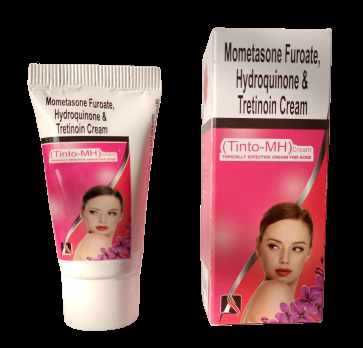
Tinto-MH Cream is a prescription skin cream from Laafon Galaxy Pharmaceuticals containing Hydroquinone 2% w/w, Tretinoin 0.025% w/w and Mometasone furoate 0.1% w/w in a 20 g tube. It is prescribed for melasma — the symmetrical brown patches that appear on the cheeks, forehead and upper lip.
The same three-drug combination is sold across India under many brand names ending in “MH”, which is simply Mometasone plus Hydroquinone, so most “MH cream” searches lead to the same formulation. It is a Schedule H medicine and cannot lawfully be supplied without a doctor’s prescription. This page sets out the uses, composition, price, side effects, correct application and duration — and, unlike most product listings, what the clinical trials behind this combination actually tested.
Last clinically reviewed: 14 September 2026 · Brand and disclosure audit performed 14 September 2026
Tinto-MH Cream — quick facts
- Brand
- Tinto-MH Cream
- Composition
- Hydroquinone 2% w/w, Tretinoin 0.025% w/w, Mometasone furoate 0.1% w/w
- Pack size
- 20 g lami tube
- MRP
- Rs 144.80
- Main use
- Melasma (facial hyperpigmentation)
- Prescription status
- Schedule H — prescription only
- How to apply
- Thin layer at night, on affected patches only
- Duration
- Time-limited; set by your prescriber
- Marketed by
- Laafon Galaxy Pharmaceuticals
- Storage
- Below 25 degrees C, dry, away from light
MH Cream Uses
MH cream — Hydroquinone 2% + Tretinoin 0.025% + Mometasone furoate 0.1% — is a prescription-only (Schedule H) topical combination used for melasma, the symmetrical brown facial pigmentation that appears most often on the cheeks, forehead and upper lip. The “MH” in every brand name is simply Mometasone plus Hydroquinone. It is not a fairness cream, not an acne treatment, and not a dark-circle treatment.
Hydroquinone-containing topical preparations were brought under Schedule H by G.S.R. 186(E) dated 6 March 2019 (the Drugs and Cosmetics (Fifth Amendment) Rules, 2019), in force from 1 April 2019 — so the cream cannot lawfully be sold without a registered medical practitioner’s prescription.[1]
What MH cream should not be used for
- Acne or pimples. Prolonged corticosteroid use on the face causes steroid acne and perioral dermatitis.[3]
- Dark circles under the eyes. The skin there is the thinnest on the body and the most vulnerable to steroid-induced thinning and visible vessels.
- General skin lightening. This is a prescription medicine for a diagnosed pigmentary disorder, not a cosmetic, and cannot lawfully be sold or promoted as one.
- Undiagnosed pigmentation. Melasma, post-inflammatory hyperpigmentation and drug-induced pigmentation look similar and are not treated the same way.[14]
Tinto-MH Cream Composition
Tinto-MH is Laafon Galaxy Pharmaceuticals’ MH cream brand. Everything on this page applies to it without exception — the schedule status, the duration limit, the evidence position on the mometasone variant, and the safety profile.
Tinto-MH is manufactured for Laafon Galaxy Pharmaceuticals at a third-party WHO-GMP certified facility. Hydroquinone, retinoid and corticosteroid topicals require appropriate segregation and handling controls, which is why this line is produced at a dedicated third-party unit rather than on a general block.
How to Use Tinto-MH Cream
Application
- Apply a thin layer to the pigmented areas only, once daily at night, on clean dry skin. Avoid the eyelids and the skin immediately around the eyes.
- Do not cover or bandage the treated area unless a doctor has told you to — occlusion increases steroid absorption and side effects.[4]
- Wash hands after applying.
Photoprotection is part of the treatment, not an optional extra
Sun exposure drives melasma, and every treatment approach includes broad-spectrum sunscreen. In a double-blind randomised trial, patients on hydroquinone 4% who used a sunscreen covering ultraviolet and visible light showed 15% greater improvement in melasma severity score at 8 weeks than those using a UV-only sunscreen of the same protection factor; both sunscreens in that trial were SPF 50 or above.[13]
Note what that finding actually supports: protection against visible light, not merely a high SPF number. Tinted or iron-oxide-containing sunscreens are the ones that block visible light. A high-SPF transparent sunscreen does not.
Do not use, or seek advice first, if
- You are pregnant or breastfeeding — prescriber decision only.[11][12]
- There is an active bacterial, viral or fungal infection on the area — the steroid can mask and worsen it.[3]
- You have had a reaction to hydroquinone, tretinoin or a topical corticosteroid before.
- It is for a child. Children absorb proportionally more topical corticosteroid and are at increased risk of slowed growth and delayed weight gain.[4]
How Long Can MH Cream Be Used?
Why MH cream treatment is usually time-limited. The corticosteroid component, not the hydroquinone, is what caps the course. General guidance for topical corticosteroids is that a course should not exceed 2 to 4 weeks regardless of potency.[3] The melasma trials for this class ran to 8 weeks.[5][6] Retail listings that state a limit give 6 to 8 weeks. Your prescriber sets the actual course and the review point — this is the one product where refilling on your own, without review, is the specific behaviour that causes harm.[9]
In a retrospective study of 60 patients using a mometasone-based triple combination for melasma, 51.7% had continued well beyond the recommended duration, and 36.7% rated their melasma as worse than before treatment.[9] Longer use does not mean better clearing.
MH Cream Side Effects
Common, early and usually settling
Peeling, redness, dryness and stinging in the first two weeks are mostly attributable to the tretinoin component, which increases skin cell turnover.
Corticosteroid-related, and the reason for the time limit
Mometasone furoate 0.1% cream is a medium-potency topical corticosteroid (US classes IV and V).[3] Documented local adverse effects of topical corticosteroids include skin atrophy — the most common, caused by the anti-mitotic effect — along with striae (which are histologically scars and are permanent), telangiectasia and purpura from connective tissue loss, perioral dermatitis from prolonged use on the face, acne, rosacea, and tachyphylaxis, where the skin develops tolerance to the steroid.[3]
Systemic effects from absorption include hypothalamic-pituitary-adrenal axis suppression, Cushing syndrome, hyperglycaemia, hypertension and glaucoma.[3] Because topical corticosteroids are immunosuppressive, they can also allow a fungal infection to persist and change appearance — presenting as tinea incognito, a real and under-recognised problem in India.[3]
In the same 60-patient study, evidence of steroid side effects was found in 26 patients (43.3%) — steroid-induced telangiectasia in all 26, skin atrophy in 19, hypertrichosis in 17 and acneiform eruption in 11.[9] One important qualification: the formulation in that study contained 1% mometasone — ten times the 0.1% in the products discussed here. The misuse pattern it documents transfers to every MH cream on the market; the absolute adverse-event rates do not, and should not be read as this product’s rates.
Hydroquinone and exogenous ochronosis
Exogenous ochronosis — a blue-black discolouration that is itself difficult to treat — is the adverse effect most associated with long-term hydroquinone use. A systematic review of 126 reported cases found a median duration of use of 5 years, with only four cases arising from courses of 3 months or shorter, and concluded that concentrations above 4% and courses longer than 3 months may be associated with new-onset ochronosis.[10]
Read that carefully, because the commercial pages usually do not: this product contains 2% hydroquinone, which sits below the concentration threshold that review identified. The ochronosis risk here is tied to duration of use far more than to the strength in the tube. Cases clustered in Fitzpatrick skin types V and VI, which covers most Indian patients.[10]
When to stop and see a doctor
Stop and seek review if you notice skin thinning, visible small blood vessels, stretch marks, spreading redness around the mouth, or new pimple-like eruptions — and do not taper by guesswork. If the pigmentation is unchanged or worse after the course your prescriber set, the answer is reassessment, not a repeat purchase.
Tinto-MH Cream Price and Pack Size
Tinto-MH Cream MRP is Rs 144.80 for the 20 g lami tube. Prices at individual pharmacies vary, and platform discounts do not change the prescription requirement — any seller offering this cream without a prescription is not complying with Schedule H.[1]
Across the Indian market, listed prices for this same three-drug combination span roughly Rs 33 to Rs 900 depending on brand and pack size, while the stated strengths are typically identical.[2] Price differences reflect brand positioning, pack size, distribution model and trade margin rather than a difference in the actives. What does vary between packs is the base or vehicle, which affects tolerability.
MH Cream Brand Variations and Similar Names
Patients frequently search one MH cream brand name while holding a different tube. Spellings such as tintin MH cream, tin tin MH cream, tisto MH cream, loook MH cream, treno MH cream, cristo MH cream and triplivate MH cream are all variations people type when looking for a hydroquinone + tretinoin + mometasone cream. These are separate brand names from different companies, and this page does not verify the composition of any brand it has not checked — always confirm the three actives and their strengths printed on your own tube before applying anything you read here, because some lookalike names contain different molecules or different strengths.
The table below lists MH cream brands of hydroquinone + mometasone + tretinoin that appear on a major Indian pharmacy platform’s molecule listing, with the marketer each one states.[2]
| Brand | Marketer as stated | Listed price range |
|---|---|---|
| Melalite XL | Abbott | Rs 389 to 645 |
| NO Scars | Torque Pharmaceuticals Pvt Ltd | Rs 50 to 900 |
| Cosmelite | Oaknet Healthcare Pvt Ltd | Rs 333 to 692 |
| Lookbrite | Torrent Pharmaceuticals Ltd | Rs 311 |
| Skinshine | Cadila Pharmaceuticals Ltd | Rs 87 to 297 |
| Metacortil-Lite | Macleods Pharmaceuticals Pvt Ltd | Rs 279 |
| HHLite | Hegde and Hegde Pharmaceutica LLP | Rs 239 |
| Getlite | Glenmark Pharmaceuticals Ltd | Rs 219 |
| Melabest | Mankind Pharma Ltd | Rs 218 |
| LOmela | Intas Pharmaceuticals Ltd | Rs 182 to 220 |
| Tinto-MH | Laafon Galaxy Pharmaceuticals | Rs 144.80 |
| Acnitin-MH | Zeelab Pharmacy Pvt Ltd | Rs 33 |
| Myfair | Zee Laboratories | Not listed |
| ELOsone-HT, Ultrabrite | Leeford Healthcare Ltd | Not listed |
| Triplivate-MH | Cutis Derma Care | Not listed |
Scroll sideways on a phone. Prices are as listed by third-party platforms on 14 September 2026 and change without notice.
MH Cream Uses in Hindi
टिंटो-एमएच क्रीम (MH Cream) क्या है: इसमें तीन दवाएं हैं — हाइड्रोक्विनोन 2% w/w, ट्रेटिनोइन 0.025% w/w और मोमेटासोन फ्यूरोएट 0.1% w/w। पैक 20 ग्राम, एमआरपी 144.80 रुपये।
उपयोग: यह क्रीम केवल मेलाज़्मा (चेहरे पर पड़ने वाले भूरे धब्बे) के इलाज के लिए है। यह फेयरनेस क्रीम नहीं है। मुंहासों या आंखों के नीचे के काले घेरों के लिए इसका उपयोग न करें।
कैसे लगाएं: रात में साफ और सूखी त्वचा पर, सिर्फ दाग वाली जगह पर पतली परत लगाएं। आंखों के आसपास न लगाएं। पट्टी या कुछ ढककर न रखें। दिन में सनस्क्रीन जरूरी है।
कितने समय तक: इसमें मौजूद स्टेरॉयड के कारण इलाज की अवधि सीमित रखी जाती है। कितने हफ्ते लगाना है, यह आपके डॉक्टर तय करेंगे। डॉक्टर की सलाह के बिना दोबारा खरीदकर लगाते रहना सबसे बड़ा जोखिम है।
सावधानी: यह शेड्यूल H दवा है — डॉक्टर के पर्चे के बिना इसे बेचना कानूनी नहीं है। गर्भावस्था या स्तनपान के दौरान डॉक्टर की सलाह के बिना इस्तेमाल न करें। त्वचा पतली होने, नसें दिखने या खिंचाव के निशान दिखने पर तुरंत डॉक्टर से मिलें।
What each ingredient does
Three drugs with three different jobs. MH cream exists as a combination because pigment in melasma is produced, transferred and inflamed by separate mechanisms, and single-agent therapy addresses only one of them.
Hydroquinone 2% — the depigmenting agent
Hydroquinone reduces melanin production in the skin. It is the component that gives MH cream its lightening effect, and the component that carries the schedule restriction: it is hydroquinone, specifically, that was written into the Note appended to Schedule H in 2019.[1]
Breastfeeding: topical hydroquinone has not been studied during breastfeeding. It is not formally contraindicated, but some authorities advise against long-term use in nursing mothers, and advise ensuring the infant’s skin does not contact treated areas and that the infant cannot ingest product from the mother’s skin.[12]
Tretinoin 0.025% — the retinoid
Tretinoin is a vitamin-A derivative. In MH cream it increases skin cell turnover, which both disperses existing pigment and improves how well hydroquinone penetrates. It is also the component most responsible for the peeling, redness and stinging patients report in the first two weeks.
On pregnancy, be precise about what the evidence says. The US National Library of Medicine’s consumer drug information for topical tretinoin does not declare it contraindicated in pregnancy; its stated instruction is to tell your doctor if you are pregnant, plan to become pregnant or are breastfeeding, and to call your doctor if you become pregnant while using it.[11]
That is weaker wording than the flat “contraindicated in pregnancy” that circulates on many Indian product pages. The practical position is unchanged, though, and this page will not soften it: melasma is common in pregnancy, there is no safety data for this three-drug MH cream combination in pregnancy, and a cream containing a retinoid and a corticosteroid is not something to start or continue on your own judgement while pregnant. That is a prescriber’s decision, made on your individual history.
Mometasone furoate 0.1% — the corticosteroid
Mometasone furoate suppresses the inflammation that both drives melasma pigmentation and is caused by the tretinoin. It makes MH cream tolerable. It is also the component that makes MH cream unsafe to continue indefinitely.
Worth knowing: the NIH consumer information for topical mometasone on its own advises avoiding use on the face unless a doctor directs it, and warns against occluding or bandaging treated skin.[4] This product is a facial cream containing that steroid, which is precisely why it is prescription-controlled and time-limited rather than freely available.
What the clinical trials actually studied — and what they did not
This is the section most MH cream brand pages leave out, and it is the most important one on this page. The pivotal efficacy evidence for “triple combination cream” was generated with a different steroid and at double the strengths of the Indian mometasone products.
| Study | Formulation actually tested | Design | Result |
|---|---|---|---|
| Taylor et al., Cutis 2003[5] | Fluocinolone acetonide 0.01% + hydroquinone 4% + tretinoin 0.05% | n=641, 8 weeks, two pooled investigator-blind RCTs | Complete clearing at week 8: 26.1% triple combination vs 4.6% for the pooled two-drug arms (P<.0001) |
| Chan et al., Br J Dermatol 2008[6] | Same fluocinolone-based formulation | 120 vs 122 evaluable, 8 weeks, Asian patients | Severity “none” or “mild” at week 8: 64.2% vs 39.4% on hydroquinone 4% (P<0.001). Related adverse events 48.8% vs 13.7% |
| Cochrane review, CD003583[7] | 23 different melasma treatments | 20 studies, 2,125 participants | Triple combination more effective than hydroquinone alone (RR 1.58, 95% CI 1.26 to 1.97). Overall verdict: study quality “generally poor and available treatments inadequate” |
| NCT06780644[8] | Fluocinolone- versus mometasone-based, head to head | n=56 estimated, single centre, Indonesia | Registered January 2025, still listed “not yet recruiting”, no results posted. This is the only registered head-to-head comparison of the two variants. |
Scroll the table sideways on a phone.
The evidence gap, stated plainly
Every efficacy figure quoted for “triple combination cream” — including the ones reproduced across Indian product listings — comes from trials of fluocinolone acetonide 0.01% + hydroquinone 4% + tretinoin 0.05%. The mometasone-based Indian products contain a different corticosteroid, at half the hydroquinone strength and half the tretinoin strength. The only registered trial directly comparing the two variants has posted no results.[8]
That does not make the mometasone version ineffective. It means the numbers are borrowed, and anyone quoting a clearance percentage for a mometasone product is extrapolating. This page will not repeat that error.
Legal status in India: Schedule H, and what that obliges
All three actives are prescription-controlled. Hydroquinone-containing topical preparations were added by amending paragraph 4 of the Note appended to Schedule H of the Drugs and Cosmetics Rules, 1945 — substituting the word “steroids” with “steroids or Hydroquinone”. The instrument is G.S.R. 186(E), dated 6 March 2019, cited as the Drugs and Cosmetics (Fifth Amendment) Rules, 2019, in force from 1 April 2019. The draft had been published as G.S.R. 922(E) dated 25 September 2018.[1]
In practice this means the pack must carry the Rule 97 caution legend, the product cannot lawfully be supplied without a prescription from a registered medical practitioner, and the pharmacy must maintain the prescription record. The full position, including the labelling wording and the distinction from Schedule H1, is set out in our Schedule H drugs list for 2026, covering all 526 molecules with labelling and dispensing rules.
Open item: the fixed-dose combination approval record
The three actives are individually Schedule H, and the combination is widely marketed in India by major manufacturers. The specific DCG(I) fixed-dose-combination approval entry for hydroquinone + tretinoin + mometasone furoate could not be independently confirmed during this review, because the CDSCO approved-FDC list is published only as downloadable PDFs that were not retrievable at the time of writing. This page therefore makes no claim about the combination’s FDC approval date or reference number. Confirm against the current CDSCO list before relying on it commercially.
Is this cream appropriate here?
Answer the three questions below. This is an educational tool, not a diagnosis, and it does not replace a dermatologist’s assessment.
Suitability check
Select one answer in each of the three questions
The result will appear here, with the reason behind it.
What the commercial listings do not tell you
On 14 September 2026 we checked four live retail and manufacturer pages for MH cream against three disclosures that matter clinically. The pattern is consistent enough to be worth publishing.
| Page checked | Flags prescription status | Says “Schedule H” | States a maximum duration |
|---|---|---|---|
| Acnitin-MH, large online pharmacy | Yes | No | Yes, 6 to 8 weeks |
| Acnitin-MH, second platform, same product | Yes | No | No |
| Skinshine, large online pharmacy | Yes | No | Yes, 6 to 8 weeks |
| Triplivate-MH, manufacturer site | No | No | No |
Scroll sideways on a phone. Audit of four publicly accessible pages, 14 September 2026.
None of the four used the words “Schedule H”. Two of four stated a duration limit, and both were the same platform’s editorial boilerplate rather than manufacturer labelling. The one manufacturer-operated page disclosed neither prescription status nor any duration limit. Given that over-long use is the documented failure mode for MH cream,[9] that is a meaningful gap in what a patient is told at the point of purchase.
Frequently asked questions
No. MH cream is intended for melasma. Using it on acne can trigger steroid-induced acneiform eruptions and perioral dermatitis, because prolonged corticosteroid use on the face causes exactly that. The skin around the eyes is the thinnest on the body and the most vulnerable to steroid-induced atrophy and telangiectasia, so this is a particularly poor choice for dark circles — which usually have a different cause altogether, such as volume loss or vascular shadowing, that no depigmenting cream addresses.
Treatment is deliberately time-limited because of the corticosteroid, not the hydroquinone. General guidance for topical corticosteroids is that a course should not exceed 2 to 4 weeks regardless of potency, and the melasma trials for this class of MH cream ran to 8 weeks rather than longer. Beyond that, the risk of skin atrophy, permanent striae, telangiectasia and tachyphylaxis rises, and in a study of patients using a mometasone-based combination, over half had continued beyond the recommended duration and 43.3% showed evidence of steroid side effects. Your prescriber sets the actual course length and review point.
Not necessarily. Listed prices for MH cream in India span roughly Rs 33 to Rs 900 across brands, while the stated strengths are typically identical at hydroquinone 2%, mometasone 0.1% and tretinoin 0.025%. Price differences reflect brand positioning, pack size, distribution model and trade margin rather than a difference in the actives. What does vary between packs is the base or vehicle, which affects tolerability. Check the strengths printed on the pack rather than inferring quality from price, and buy only against a valid prescription.
Not on your own decision. Melasma is common in pregnancy, and this is exactly the situation where self-medication is most tempting and least advisable. There is no safety data for this three-drug combination in pregnancy. Topical hydroquinone has not been studied during breastfeeding; it is not formally contraindicated, but some authorities advise against long-term use in nursing mothers and advise keeping the infant’s skin away from treated areas. The NIH consumer information for topical tretinoin instructs patients to tell their doctor if pregnant or planning pregnancy. Pregnancy-related melasma also frequently fades on its own after delivery, so the balance of benefit and risk is different. Discuss it with your doctor.
A thin layer over the pigmented patches only, once daily at night. More cream does not clear pigment faster; it increases the amount of corticosteroid absorbed, which is what drives atrophy, telangiectasia and, with enough surface area and duration, systemic effects such as adrenal suppression. Applying it across the whole face rather than to the patches is the most common way patients unintentionally escalate their steroid exposure. If a large amount has been applied over a wide area for a prolonged period, or you notice thinning, visible vessels or stretch marks, stop and see your doctor rather than tapering by guesswork.
No, and the distinction is a legal one as well as a clinical one. This is a prescription medicine for a diagnosed pigmentary disorder, restricted under Schedule H since April 2019. It is not a cosmetic and cannot lawfully be sold or promoted as one. Using a medium-potency corticosteroid on healthy facial skin for cosmetic lightening carries all of the steroid risks with none of the therapeutic justification, and is a recognised driver of steroid-damaged facial skin and steroid-modified fungal infection in India.
Trade, distribution and PCD enquiries
Laafon Galaxy Pharmaceuticals supplies dermatology products to distributors, PCD franchise partners and institutional buyers. Tell us the pack, quantity and territory you need and we will respond with pricing and documentation. This is a business enquiry channel and is not a route to obtain prescription medicines without a prescription.
Laafon Galaxy Pharmaceuticals, Karnal, Haryana · See the full cream and topical range.
References
- Ministry of Health and Family Welfare, Government of India. G.S.R. 186(E), dated 6 March 2019 — Drugs and Cosmetics (Fifth Amendment) Rules, 2019 (Hydroquinone included in the Note to Schedule H, Drugs and Cosmetics Rules, 1945). Gazette of India, Extraordinary, Part II, Section 3, Sub-section (i). In force 1 April 2019. Available from: https://cdsco.gov.in/opencms/opencms/en/Acts-and-rules/Drugs-Rules/ Accessed September 2026.
- Tata 1mg. Hydroquinone + Mometasone + Tretinoin — brands and marketers. Available from: https://www.1mg.com/generics/hydroquinone-mometasone-tretinoin-401915 Accessed September 2026. (Secondary source, used for brand and marketer cross-reference only.)
- Gabros S, Nessel TA, Zito PM. Topical corticosteroids. In: StatPearls [Internet]. Treasure Island (FL): StatPearls Publishing; updated 26 April 2025. Bookshelf ID NBK532940. Available from: https://www.ncbi.nlm.nih.gov/books/NBK532940/ Accessed September 2026.
- Mometasone Topical. MedlinePlus Drug Information [Internet]. Bethesda (MD): National Library of Medicine (US). Available from: https://medlineplus.gov/druginfo/meds/a687014.html Accessed September 2026.
- Taylor SC, Torok H, Jones T, Lowe N, Rich P, Tschen E, et al. Efficacy and safety of a new triple-combination agent for the treatment of facial melasma. Cutis. 2003;72(1):67-72. PMID 12889718. Available from: https://pubmed.ncbi.nlm.nih.gov/12889718/ Accessed September 2026.
- Chan R, Park KC, Lee MH, Lee ES, Chang SE, Leow YH, et al. A randomized controlled trial of the efficacy and safety of a fixed triple combination (fluocinolone acetonide 0.01%, hydroquinone 4%, tretinoin 0.05%) compared with hydroquinone 4% cream in Asian patients with moderate to severe melasma. Br J Dermatol. 2008;159(3):697-703. PMID 18616780. Available from: https://pubmed.ncbi.nlm.nih.gov/18616780/ Accessed September 2026.
- Rajaratnam R, Halpern J, Salim A, Emmett C. Interventions for melasma. Cochrane Database Syst Rev. 2010;(7):CD003583. PMID 20614435. Available from: https://www.cochrane.org/evidence/CD003583 Accessed September 2026.
- ClinicalTrials.gov. NCT06780644 — Comparison of effectiveness and safety of triple combination cream of fluocinolone acetonide 0.01%, hydroquinone 4%, tretinoin 0.05% with mometasone furoate 0.1%, hydroquinone 4%, tretinoin 0.05% in the treatment of melasma. Universitas Indonesia; registered January 2025, record last updated March 2025, no results posted. Available from: https://clinicaltrials.gov/study/NCT06780644 Accessed September 2026.
- Majid I. Mometasone-based triple combination therapy in melasma: is it really safe? Indian J Dermatol. 2010;55(4):359-362. PMID 21430890. Available from: https://pubmed.ncbi.nlm.nih.gov/21430890/ Accessed September 2026. (Formulation studied contained 1% mometasone, not 0.1%.)
- Ishack S, Lipner SR. Exogenous ochronosis associated with hydroquinone: a systematic review. Int J Dermatol. 2022;61(6):675-684. PMID 34486734. Available from: https://pubmed.ncbi.nlm.nih.gov/34486734/ Accessed September 2026.
- Tretinoin Topical. MedlinePlus Drug Information [Internet]. Bethesda (MD): National Library of Medicine (US). Available from: https://medlineplus.gov/druginfo/meds/a682437.html Accessed September 2026.
- Hydroquinone. In: Drugs and Lactation Database (LactMed) [Internet]. Bethesda (MD): National Institute of Child Health and Human Development; 2006-. Bookshelf ID NBK500669. PMID 29999728. Available from: https://www.ncbi.nlm.nih.gov/books/NBK500669/ Accessed September 2026.
- Castanedo-Cazares JP, Hernandez-Blanco D, Carlos-Ortega B, Fuentes-Ahumada C, Torres-Alvarez B. Near-visible light and UV photoprotection in the treatment of melasma: a double-blind randomized trial. Photodermatol Photoimmunol Photomed. 2014;30(1):35-42. PMID 24313385. Available from: https://pubmed.ncbi.nlm.nih.gov/24313385/ Accessed September 2026.
- Handel AC, Miot LDB, Miot HA. Melasma: a clinical and epidemiological review. An Bras Dermatol. 2014;89(5):771-782. PMID 25184917. Available from: https://pubmed.ncbi.nlm.nih.gov/25184917/ Accessed September 2026.
Disclaimer
This page is technical and educational information for pharmacy, healthcare and trade readers. It is not medical advice, not a diagnosis, and not a substitute for consultation with a registered medical practitioner. Hydroquinone, tretinoin and mometasone furoate are prescription-controlled substances in India; nothing here should be read as encouragement to obtain or use them without a prescription.
Clinical and regulatory positions change. Schedule classifications are amended by gazette notification, pharmacopoeial texts are revised, and prices are revised by the manufacturer and by the National Pharmaceutical Pricing Authority. Every figure on this page carries its source and the date it was checked; verify against the current instrument before relying on it commercially. Where a claim could not be independently verified at the time of writing, this page says so rather than filling the gap.
Written and reviewed by Darshan Singh, M.Sc. Organic Chemistry, D.Pharm, with over 23 years in pharmaceutical quality control, quality assurance and drug regulatory affairs.