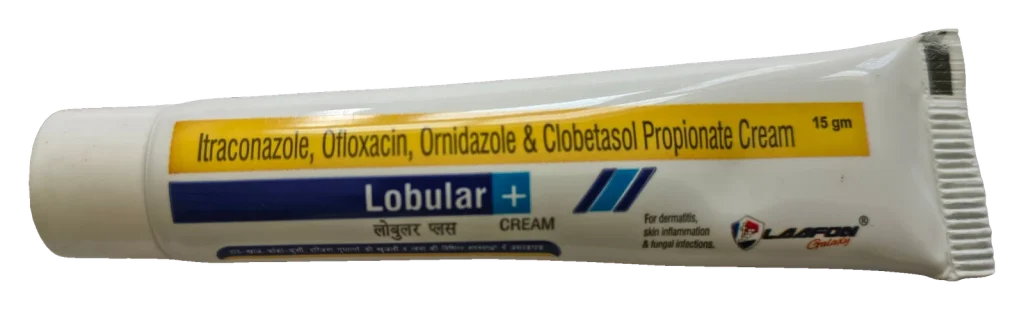
Itraconazole, ofloxacin, ornidazole and clobetasol cream: what it is
Itraconazole, ofloxacin, ornidazole and clobetasol propionate cream is a four-drug fixed-dose combination (FDC) sold in India for inflamed, itchy skin with a suspected fungal or bacterial infection. It mixes one antifungal (itraconazole), two antibacterials (ofloxacin and ornidazole) and clobetasol propionate, one of the strongest topical steroids. Three of its four ingredients are Schedule H drugs[1], so it is a prescription medicine, not an over-the-counter cream.
Dermatologists have criticised this combination in particular. A near-identical cream with terbinafine instead of itraconazole was banned in 2018[2]. A 2020 dermatology editorial reported that the itraconazole version had no DCGI marketing permission and was being licensed by state authorities[3]. Use it only when a doctor has examined the skin and prescribed it, and only for a short course.
Ringworm (daad) or “sobi” patches? Indian expert guidance strongly discourages using steroid creams to treat tinea[4]. A steroid can calm the itch for a few days while the fungus keeps spreading underneath. If you are not sure what the rash is, see a doctor before you use this cream.
Composition: what each of the four ingredients does
Strengths are those printed for the Lobular Plus brand. Other brands of the same combination usually carry the same strengths, but check the carton.
Scroll sideways to see the full table →
| Ingredient | Strength | Drug class | Why it is in the cream | What the evidence says about using it on skin |
|---|---|---|---|---|
| Itraconazole | 1.00% w/w | Triazole antifungal | Treats fungal infection | Indian guidance recommends itraconazole by mouth for tinea that needs systemic treatment[4]. A 2020 review found no published study of ordinary itraconazole cream for tinea and doubted that 1% dissolves in a normal cream base[3]. One 2022 trial tested a special nano-vesicle cream at 0.1–0.5%, a different formulation from this one[5]. |
| Ofloxacin | 0.75% w/w | Fluoroquinolone antibacterial | Treats bacterial infection | Rarely, if ever, used on skin[3]. CDSCO’s dermatology expert committee rejected a similar clobetasol + terbinafine + ofloxacin cream, warning of bacterial and fungal resistance[6]. |
| Ornidazole | 2.00% w/w | Nitroimidazole antimicrobial | Acts on anaerobic bacteria and protozoa | Drugs in this class are used by mouth or injection against anaerobic and protozoal infections[7]. On skin, ornidazole is rarely, if ever, used[3]. |
| Clobetasol propionate | 0.05% w/w | Super-high-potency corticosteroid | Reduces redness, swelling and itch | Effective for steroid-responsive rashes such as eczema and psoriasis, within strict limits: no more than 2 weeks in a row, 50 g a week, and not on the face, groin or underarms[8]. Indian guidance strongly discourages steroids for tinea[4]. |
Ingredient by ingredient
Clobetasol propionate 0.05%: the ingredient that sets the safety limits
- Potency
- Super-high potency, the strongest group of topical steroids[8].
- Labelled limits
- Treatment beyond 2 consecutive weeks is not recommended; total no more than 50 g a week; no bandage or wrap over it; not on the face, groin or underarms; not recommended under 12 years[8].
- Absorption risk
- It can suppress the body’s own steroid (HPA) axis at doses as low as 2 g a day[8]. A 15 g tube is about a week of that amount.
- If infection is present
- The label says an appropriate antifungal or antibacterial should be used. That is the reasoning behind combination creams, but the choice of agent matters[8].
Itraconazole 1%: an important oral antifungal, with little evidence as a cream
- Established use
- Oral itraconazole is one of the two preferred systemic drugs for tinea in the Indian expert consensus (ECTODERM India)[4].
- As a cream
- A 2020 editorial by Indian dermatologists found no indexed study of conventional topical itraconazole for skin dermatophyte infection. It also noted that the most soluble formulation achieved in trials was 0.7%[3].
- Newer data
- A 2022 Egyptian trial found benefit from itraconazole in aspasome (nano-vesicle) creams at 0.1–0.5%. It did not test a 1% conventional cream or any steroid combination[5].
- Resistance concern
- The authors warned that unsupervised topical use could breed itraconazole resistance in the fungi behind India’s tinea epidemic[3].
Ofloxacin 0.75%: an antibiotic usually given by other routes
- Class
- Fluoroquinolone antibacterial.
- On skin
- Described in the dermatology literature as rarely, if ever, used topically[3].
- Regulator’s view
- In January 2021 CDSCO’s Subject Expert Committee (Dermatology) did not recommend a clobetasol + terbinafine + ofloxacin cream. It said the combination was not in any standard therapeutic guideline and could lead to bacterial and fungal resistance[6].
Ornidazole 2%: a nitroimidazole meant for anaerobes and protozoa
Itraconazole, ofloxacin, ornidazole and clobetasol cream uses
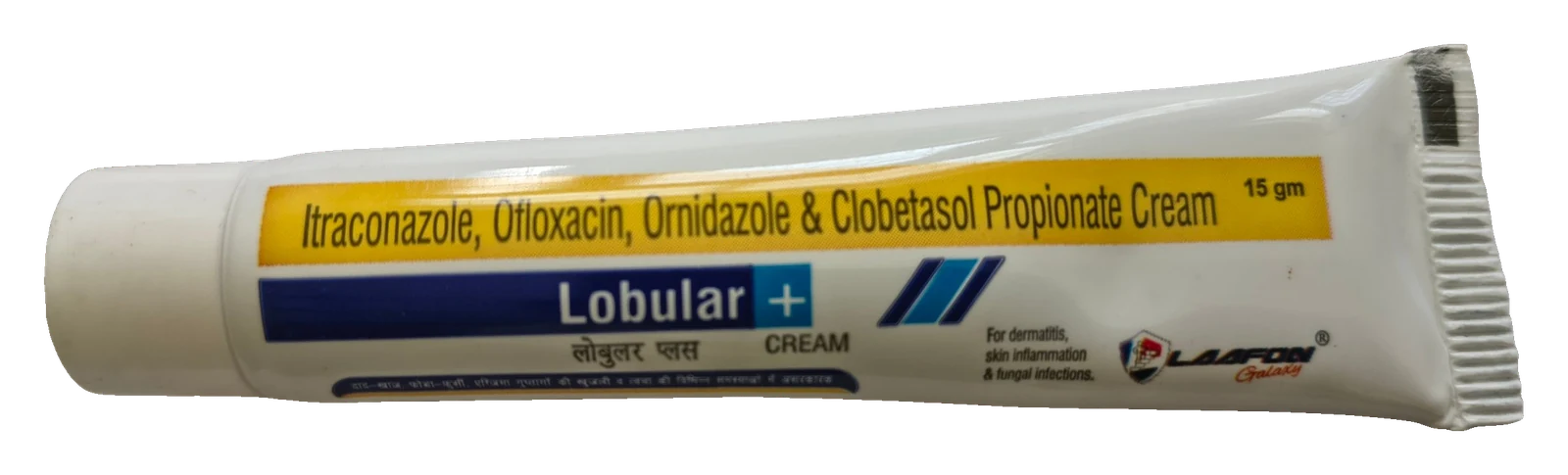
Packs of this combination, including Lobular Plus, are labelled for dermatitis, skin inflammation and fungal infections. Here is how current guidance sorts those uses.
When a doctor may prescribe it
- A short course for an inflamed, itchy rash that the doctor judges to be infected, where a strong steroid plus antimicrobial cover is wanted for a few days.
- Only on body skin, never under a bandage, for no more than the stated 2 weeks[8].
Not the right first choice for
- Ringworm (tinea, daad). Guidance prefers a plain topical azole for new, localised tinea and strongly discourages steroids[4].
- “Sobi” (tinea versicolor). Treated with antifungals alone; see the box below.
- Itching in the groin or genitals, or rashes on the face. Clobetasol should not be used there[8].
- Acne, boils or open wounds. Clobetasol can itself cause acne-like eruptions and secondary infection[10].
Why steroid combination creams worry dermatologists: Indian dermatologists have linked antifungal-plus-potent-steroid FDC creams to the epidemic of chronic, recalcitrant tinea in India since 2014. Self-medication on a chemist’s advice is a recurring pattern[3].
Is this cream right for “sobi” skin disease (tinea versicolor)?
“Sobi” is a common North Indian name for tinea (pityriasis) versicolor: light or dark, finely scaly patches, usually on the chest, back and neck. It is caused by Malassezia, a yeast that normally lives on the skin, so the patches often come back[9].
What the evidence supports
Where this cream fits
It is not a standard sobi treatment. Sobi is not usually inflamed, so the steroid adds risk without benefit, and the two antibacterials have no role. Pale patches can also be other conditions, such as vitiligo, so get a diagnosis first.
Before you apply it: a 4-question safety check
This applies the clobetasol label limits to your situation. It does not replace a doctor’s examination.
Answer all four questions to see the result
The result uses the limits in the clobetasol propionate prescribing information[8].
Side effects and warnings
No published safety study covers this exact four-drug cream. The known risks come mainly from its clobetasol content.
| Risk | What to watch for |
|---|---|
| Local skin effects | Dryness, irritation, acne-like eruptions, lightening of skin colour, rash around the mouth, stretch marks (striae), allergic contact dermatitis, secondary infection[10] |
| Masked or worsened fungal infection | Ringworm that looks better, then spreads or keeps returning after the cream is stopped[3] |
| Steroid absorbed into the body | HPA-axis suppression, possible at doses as low as 2 g a day; greater risk in children, over large areas, under occlusion or for long periods[8] |
| Antimicrobial resistance | Experts have raised concerns about bacterial and fungal resistance with topical antibiotic-antifungal-steroid FDCs[6] |
Stop and see a doctor if the rash spreads, oozes or develops pus, if new pimples or thin, shiny skin appear, or if it is not clearly better within the period your doctor gave you. Do not reuse a leftover tube on a new rash.
Regulatory status in India (as of 27 October 2026)
- Schedule HPrescription only. Clobetasol propionate, ofloxacin and ornidazole are each listed in Schedule H to the Drugs Rules, 1945[1]. A chemist should dispense this cream only against a prescription.
- 07.09.2018The terbinafine version was banned. Clobetasol + Ofloxacin + Ornidazole + Terbinafine was prohibited under Section 26A of the Drugs and Cosmetics Act by S.O. 4672(E)[2].
- 2020Itraconazole version criticised. Dermatologists reported that the itraconazole replacement had no DCGI marketing permission and was being licensed by state drug authorities, mostly in Uttarakhand, Himachal Pradesh and Punjab[3].
- 12.01.2021Expert committee position. CDSCO’s SEC (Dermatology & Allergy) declined a related clobetasol + terbinafine + ofloxacin cream, citing resistance risk and needless exposure to a potent steroid[6].
- 02.08.2024Not on the 156-FDC prohibition. The four-drug itraconazole combination does not appear in the August 2024 list of prohibited FDCs[11].
What this means: on the sources above, the combination is not on a prohibition list we checked, so it remains on sale. Its regulatory position could change if CDSCO reviews it. Check this page’s review date, and our list of 156 FDCs banned in 2024 for how such reviews have gone.
Lobular Plus Cream: Laafon Galaxy’s brand of this combination
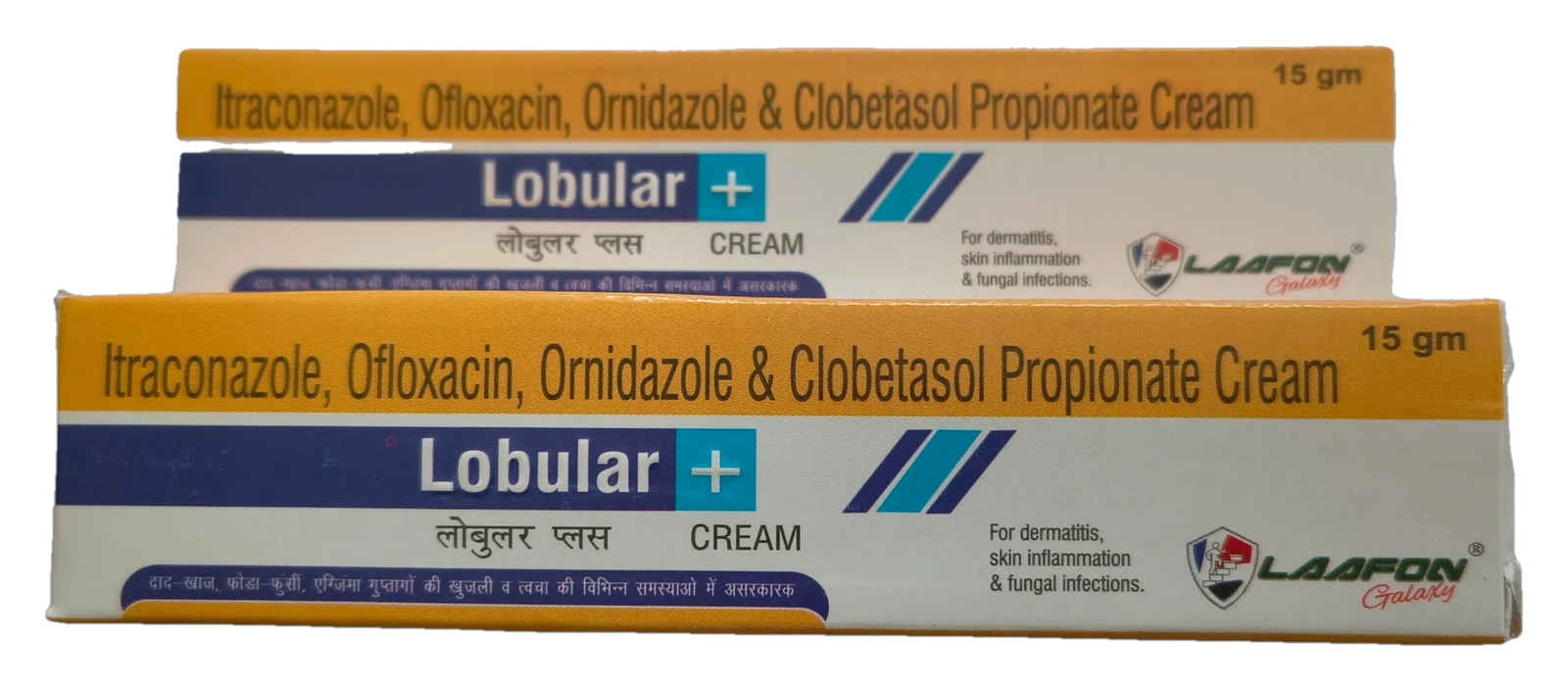
| Brand | Lobular Plus (Lobular +) Cream |
|---|---|
| Composition | Itraconazole 1.00% w/w, Ofloxacin 0.75% w/w, Ornidazole 2.00% w/w, Clobetasol propionate 0.05% w/w |
| Pack | 15 g laminated tube in carton |
| MRP | ₹90 per 15 g tube (October 2026) |
| Sale status | Prescription medicine (Schedule H ingredients) |
| Shelf life & storage | 2 years; store below 30°C, away from light and moisture |
| Marketed by | Laafon Galaxy Pharmaceuticals |
Everything on this page about the combination, including the regulatory history and dermatologists’ concerns, applies to Lobular Plus. For a plain steroid-free antifungal option, ask a doctor. Laafon Galaxy also markets Itco-200 (itraconazole 200 mg capsules), the oral form that guidance supports for tinea needing systemic treatment[4].
Distributors, stockists and chemists: Lobular Plus enquiries
For trade rates, PCD franchise terms or stock availability for Lobular Plus 15 g, message Laafon Galaxy on WhatsApp. Please mention your firm name, town and drug licence type. This is a prescription medicine, so we don’t take orders from patients.
हिंदी में सार: यह क्रीम किस काम आती है?
इट्राकोनाज़ोल, ओफ़्लॉक्सासिन, ऑर्निडाज़ोल और क्लोबेटासोल प्रोपियोनेट क्रीम चार दवाओं का मिश्रण है: एक फफूंदरोधी (एंटीफ़ंगल), दो जीवाणुरोधी (एंटीबैक्टीरियल) और एक बहुत तेज़ स्टेरॉयड (क्लोबेटासोल)। यह डॉक्टर के पर्चे पर मिलने वाली (शेड्यूल H) दवा है।
- दाद या सोबी (टीनिया वर्सिकलर) पर इसे अपने आप न लगाएँ। स्टेरॉयड वाली क्रीम कुछ दिन खुजली दबा देती है, पर फफूंद अंदर फैलता रहता है और दाद बार-बार लौट आता है।
- चेहरे, जांघों के जोड़, गुप्तांगों या बगल पर, और 12 साल से कम उम्र के बच्चों पर इसका इस्तेमाल न करें।
- लगातार 2 हफ़्ते से ज़्यादा न लगाएँ, और इसके ऊपर पट्टी न बाँधें।
- गर्भावस्था या स्तनपान के दौरान इसे केवल डॉक्टर की सलाह पर ही इस्तेमाल करें।
Frequently asked questions
It is sold for inflamed, itchy skin with a suspected fungal or bacterial infection, and its packs mention dermatitis, skin inflammation and fungal infections. Because it contains a super-potent steroid, it should be used only when a doctor has examined the rash, for no more than 2 weeks in a row, and not on the face, groin or underarms[8].
It is not a standard treatment. Sobi (tinea versicolor) is caused by Malassezia yeast and is treated first with topical antifungals such as ketoconazole, zinc pyrithione or terbinafine, or with oral itraconazole or fluconazole in severe cases[9]. A steroid is not needed for these usually non-inflamed patches.
No, unless a dermatologist specifically tells you to. Clobetasol propionate prescribing information says it should not be used on the face, groin or underarms, where thin skin absorbs more steroid and side effects such as thinning and stretch marks appear sooner[8].
No. Clobetasol propionate, ofloxacin and ornidazole are each listed in Schedule H, so the cream should be sold only on a registered medical practitioner’s prescription[1]. Our Schedule H drugs list explains the labelling and dispensing rules.
The itraconazole version is not on the prohibition lists we checked, which run up to the August 2024 notification of 156 FDCs[11]. The terbinafine version (clobetasol + ofloxacin + ornidazole + terbinafine) was banned on 7 September 2018 by S.O. 4672(E)[2]. Dermatologists have reported that the itraconazole version lacks DCGI marketing permission[3].
No. Itraconazole is used as the base molecule, not as a nitrate salt. The nitrate salts in antifungal creams belong to other azoles, such as miconazole nitrate, econazole nitrate and sertaconazole nitrate. Searches for “itraconazole nitrate” usually mean either an itraconazole cream or a miconazole nitrate cream, so check the label.
Clobetasol propionate is not recommended for children under 12, who are at greater risk of steroid absorption effects[8]. No safety data exist for this four-drug cream in pregnancy or breastfeeding, so it should be used then only if a doctor decides the benefit outweighs the risk.
Only for the period your doctor states. Clobetasol labelling says treatment beyond 2 consecutive weeks is not recommended and total use should not exceed 50 g a week[8]. If the rash is not clearly better by then, the diagnosis needs a second look rather than a longer course.
Related on laafon.com
Not sure whether a skin cream needs a prescription? Check the molecule against India’s Schedule H list before you buy.
Check the Schedule H drugs listReferences
- Central Drugs Standard Control Organisation. The Drugs and Cosmetics Act, 1940 and the Drugs and Cosmetics Rules, 1945 (as amended): Schedule H. New Delhi: Ministry of Health and Family Welfare, Government of India. Available from: https://cdsco.gov.in/opencms/opencms/en/Acts-Rules. Accessed October 2026.
- Central Drugs Standard Control Organisation. List of drugs prohibited for manufacture and sale through gazette notifications under Section 26A of the Drugs & Cosmetics Act 1940 (status as on 22.11.2021), entry 406: Clobetasol + Ofloxacin + Ornidazole + Terbinafine, S.O. 4672(E) dated 07.09.2018. Available from: cdsco.gov.in (PDF). Accessed October 2026.
- Verma SB, Saraswat A, Rao PN, Dogra S. Topical itraconazole formulations: unscrupulous pharmaceutical companies and lax Indian drug regulators endangering a precious drug. Indian Dermatol Online J. 2020;11(5):806-811. doi:10.4103/idoj.IDOJ_659_20. Available from: https://pmc.ncbi.nlm.nih.gov/articles/PMC7678552/. Accessed October 2026.
- Rajagopalan M, Inamadar A, Mittal A, Miskeen AK, Srinivas CR, Sardana K, et al. Expert Consensus on The Management of Dermatophytosis in India (ECTODERM India). BMC Dermatol. 2018;18(1):6. doi:10.1186/s12895-018-0073-1. Available from: https://pubmed.ncbi.nlm.nih.gov/30041646/. Accessed October 2026.
- Lamie C, Elmowafy E, Ragaie MH, Attia DA, Mortada ND. Assessment of antifungal efficacy of itraconazole loaded aspasomal cream: comparative clinical study. Drug Deliv. 2022;29(1):1345-1357. doi:10.1080/10717544.2022.2067601. Available from: https://pubmed.ncbi.nlm.nih.gov/35506466/. Accessed October 2026.
- Central Drugs Standard Control Organisation. Recommendations of the 54th Subject Expert Committee (Dermatology & Allergy) meeting held on 12.01.2021, File FDC/MA/20/000070. New Delhi: CDSCO; 2021. Available from: cdsco.gov.in (PDF). Accessed October 2026.
- Lamp KC, Freeman CD, Klutman NE, Lacy MK. Pharmacokinetics and pharmacodynamics of the nitroimidazole antimicrobials. Clin Pharmacokinet. 1999;36(5):353-373. doi:10.2165/00003088-199936050-00004. Available from: https://pubmed.ncbi.nlm.nih.gov/10384859/. Accessed October 2026.
- Sun Pharmaceutical Industries, Inc. Clobetasol propionate gel 0.05%, cream USP 0.05%, ointment USP 0.05%: prescribing information (revised July 2025). US Food and Drug Administration, FDALabel. Available from: nctr-crs.fda.gov. Accessed October 2026.
- Gupta AK, Foley KA. Antifungal treatment for pityriasis versicolor. J Fungi (Basel). 2015;1(1):13-29. doi:10.3390/jof1010013. Available from: https://pubmed.ncbi.nlm.nih.gov/29376896/. Accessed October 2026.
- Encube Ethicals Pvt. Ltd. Clobetasol propionate cream USP, 0.05%: prescribing information, adverse reactions. Available from: medlibrary.org. Accessed October 2026.
- Central Drugs Standard Control Organisation. List of prohibited FDC drugs: 156 FDCs, notifications dated 02.08.2024. Available from: cdsco.gov.in (PDF). Accessed October 2026.
Disclaimer: This page is technical and educational information for patients, pharmacists and healthcare professionals. It is not medical advice and does not replace an examination by a registered medical practitioner. Indian drug schedules, FDC approvals and prohibitions change by gazette notification; check the review date above and the current CDSCO position before relying on any regulatory statement. Laafon Galaxy Pharmaceuticals markets Lobular Plus.