Laafon Galaxy own brand · Paediatric antibiotic
Postpod Dry Syrup at a glance
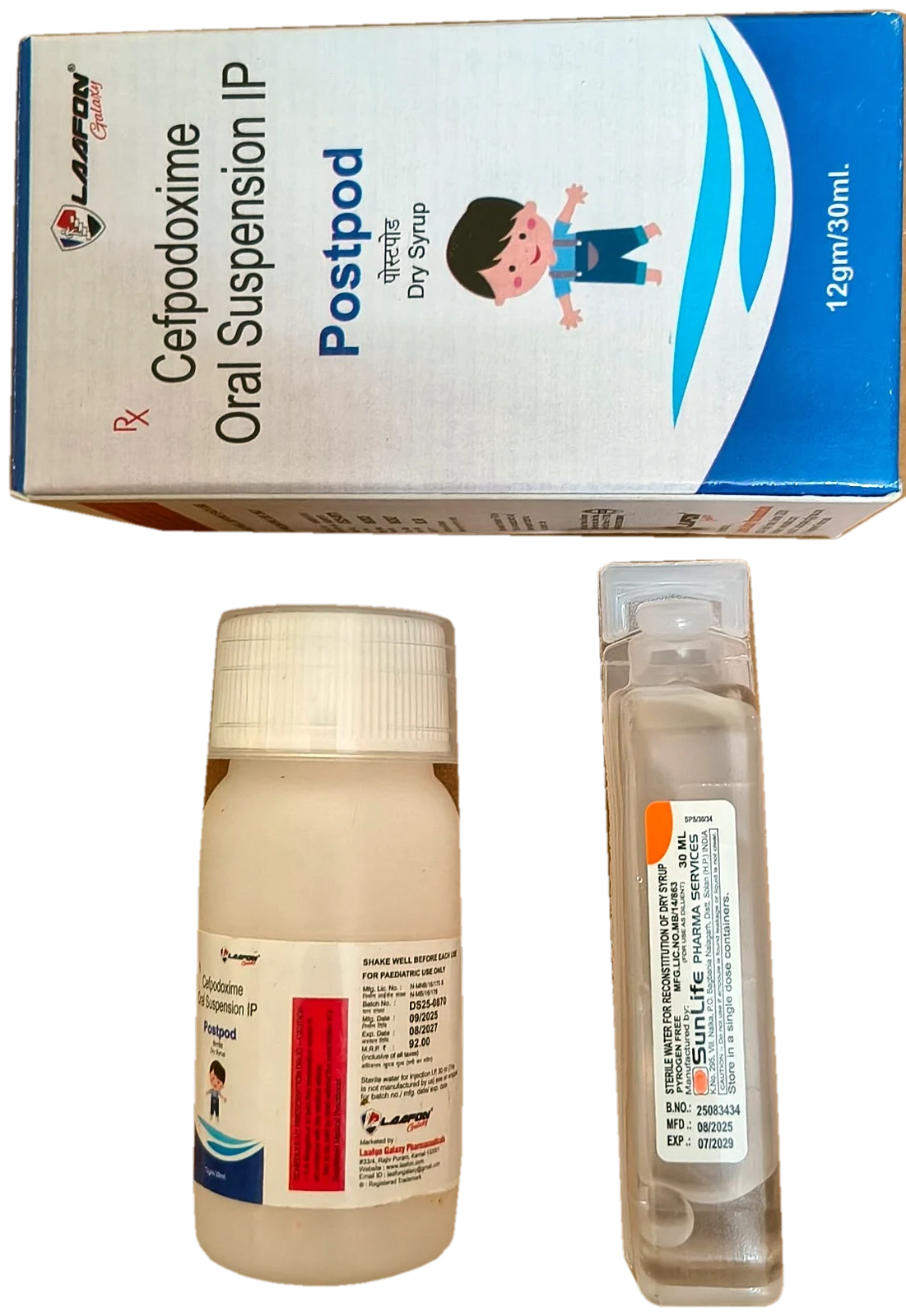
Postpod Dry Syrup is Cefpodoxime Oral Suspension IP: a dry powder that becomes an oral suspension containing cefpodoxime proxetil equivalent to 50 mg cefpodoxime in every 5 ml once mixed with the sterile water supplied in the pack.[1] Cefpodoxime is a third-generation oral cephalosporin antibiotic.[3]
It is a Schedule H1 prescription medicine for children, used only for bacterial infections a doctor has diagnosed. It does not work for colds, flu or other viral infections. The dose is set by the doctor for the child’s weight.
- Rx · Schedule H1
- WHO AWaRe: Watch
- For paediatric use only
- MRP ₹92
| Generic name | Cefpodoxime Oral Suspension IP |
|---|---|
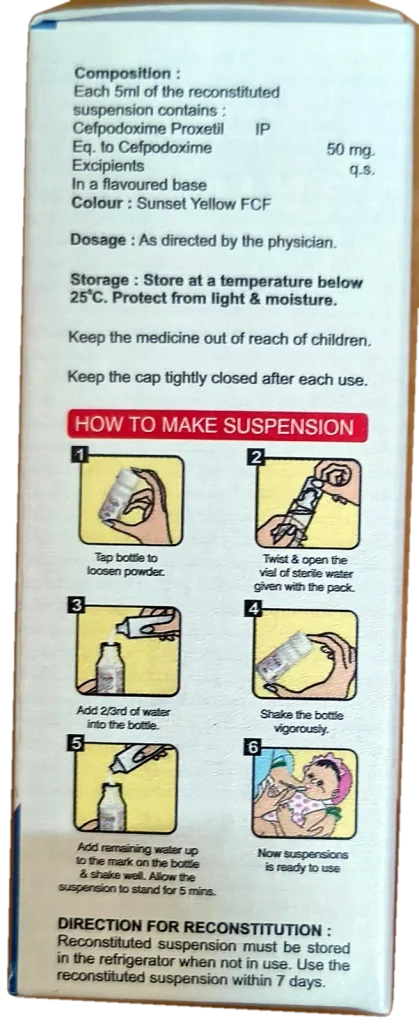
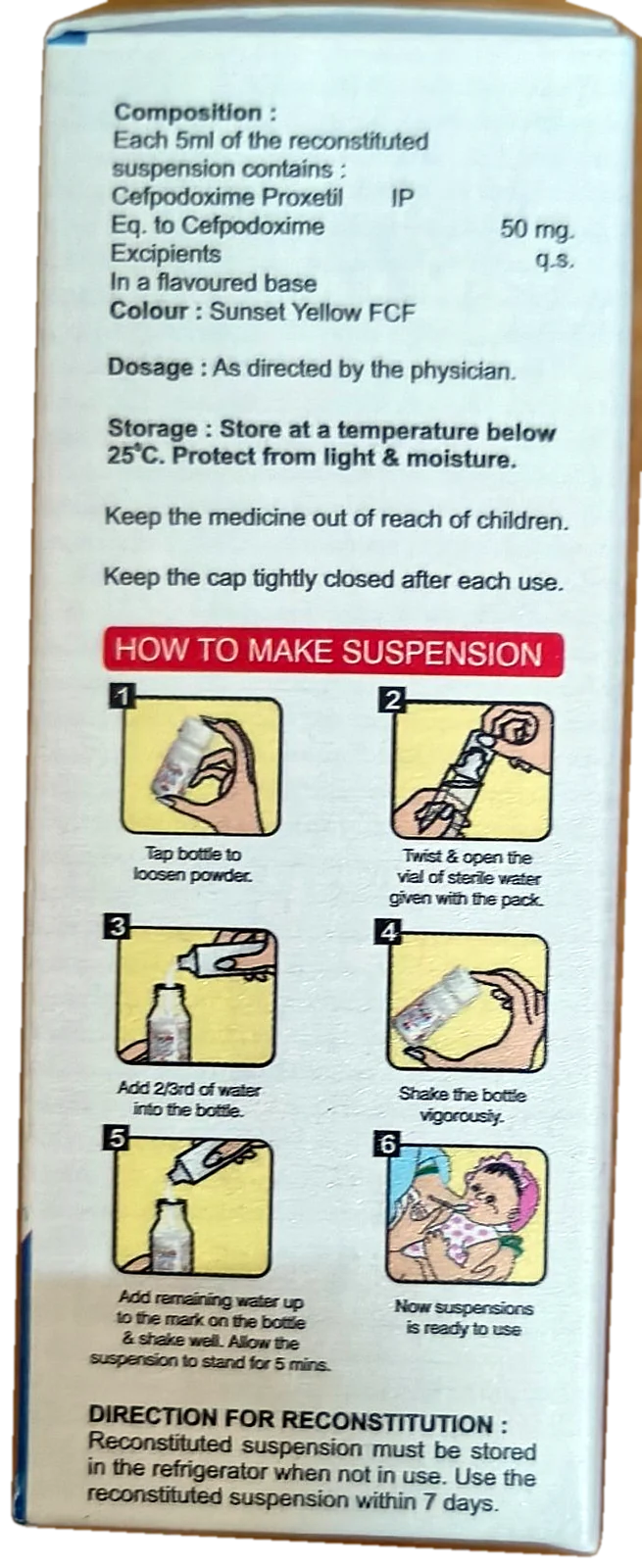
| Composition (per 5 ml, after mixing) | Cefpodoxime proxetil IP eq. to cefpodoxime 50 mg; excipients q.s.; flavoured base; colour: Sunset Yellow FCF |
| Pack | 12 g dry powder in a bottle marked for 30 ml, with a 30 ml sterile water ampoule for mixing |
| Drug class | Third-generation cephalosporin (beta-lactam) antibiotic |
| Legal status (India) | Schedule H1: sold only on a registered medical practitioner’s prescription |
| MRP | ₹92.00 per pack (inclusive of all taxes) |
| Shelf life | 24 months (mfd. 09/2025, exp. 08/2027 on the current batch) |
| Storage | Dry powder below 25°C, protected from light and moisture. After mixing: refrigerate and use within 7 days |
| Marketed by | Laafon Galaxy Pharmaceuticals, #33/4 Rajiv Puram, Karnal 132001, Haryana |
The molecule
What is cefpodoxime and how does it work?
Cefpodoxime is a third-generation cephalosporin antibiotic. It kills bacteria by blocking the synthesis of their cell wall.[3] In Postpod it is present as cefpodoxime proxetil, a prodrug ester. The body converts it to active cefpodoxime as it is absorbed from the gut.
Uses
What is Postpod Dry Syrup used for?
In children, cefpodoxime oral suspension is approved for mild-to-moderate bacterial infections caused by susceptible organisms, including:[2]
- Acute otitis media (middle-ear infection)
- Pharyngitis and tonsillitis (bacterial throat infection)
- Acute maxillary sinusitis
The same label also covers adult indications such as community-acquired pneumonia, uncomplicated skin infections and uncomplicated urinary tract infections.[2] Older children and adults are usually given tablets, such as our Postpod-200 cefpodoxime 200 mg tablets.
Why it is a “Watch” antibiotic. WHO’s AWaRe system places cefpodoxime in the Watch group.[6] Watch antibiotics carry a higher risk of driving resistance, so they are kept for infections where they are genuinely indicated. Give every dose for the full course the doctor prescribes. Do not save leftovers or reuse them for another child.
Prescriber reference: paediatric dosing in the US FDA-approved label
Postpod’s carton says “Dosage: As directed by the physician.”[1] This table is for doctors and pharmacists, not for parents to work out a dose. It reproduces the approved US label for children aged 2 months to 12 years.[2]
| Infection | Dose | Frequency | Maximum | Duration |
|---|---|---|---|---|
| Acute otitis media | 5 mg/kg | Every 12 h | 200 mg/dose; 400 mg/day | 5 days |
| Pharyngitis / tonsillitis | 5 mg/kg | Every 12 h | 100 mg/dose; 200 mg/day | 5 to 10 days |
| Acute maxillary sinusitis | 5 mg/kg | Every 12 h | 200 mg/dose; 400 mg/day | 10 days |
Scroll sideways to see all columns.
- Safety and efficacy in infants under 2 months have not been established.[2]
- Severe renal impairment (creatinine clearance below 30 ml/min): the dosing interval is extended to every 24 hours. Patients on haemodialysis are dosed three times a week, after dialysis.[2]
- The label for the Indian market and the treating doctor’s judgement take priority over this summary.
Reconstitution
How to mix Postpod Dry Syrup
These are the steps printed on the Postpod carton.[1] Use only the sterile water supplied in the pack.
- Tap the bottle to loosen the powder.
- Twist and open the ampoule of sterile water supplied with the pack.
- Add about two-thirds of the water to the bottle.
- Close the cap and shake the bottle vigorously.
- Add the remaining water up to the mark on the bottle and shake well. Let the suspension stand for 5 minutes.
- The suspension is ready to use. Shake well before each dose.
After mixing: keep the suspension in the refrigerator when it is not in use, and use it within 7 days. Keep the cap tightly closed, and keep the bottle out of children’s reach.[1] Measure each dose with a measuring cup or oral syringe, not a kitchen spoon.
Some other cefpodoxime suspensions carry different directions. The US label, for example, allows 14 days refrigerated.[2] Always follow the label on the pack in your hand. For Postpod, that is 7 days.
Pick the mixing date to see the 7-day use-by date printed on the Postpod carton.
Safety
Side effects, precautions and interactions
Common side effects in children
From paediatric trials of 2,128 children:[2]
- Diarrhoea: 6% overall, rising to 12.8% in infants and toddlers
- Nappy (diaper) rash or fungal skin rash: 2% overall; 8.5% in infants and toddlers
- Vomiting: 2.3%
- Other skin rashes: 1.8%
Get medical help urgently if
Who should not take it
Regulatory status in India
Why Postpod is a Schedule H1 medicine
Cefpodoxime was added to Schedule H1 of the Drugs Rules, 1945 by notification G.S.R. 588(E) of 30 August 2013.[5] Schedule H1 took effect on 1 March 2014. Schedule H1 was created to bring many newer antibiotics, including third- and fourth-generation cephalosporins, under tighter control and curb their misuse. What it means in practice:
- The label carries the boxed red warning “Schedule H1 Drug – Warning: It is dangerous to take this preparation except in accordance with the medical advice. Not to be sold by retail without the prescription of a Registered Medical Practitioner.”[5] You can see it in red on the Postpod bottle label above.
- Chemists must enter each supply in a separate Schedule H1 register (patient, prescriber, drug, quantity) and keep it for three years. Our Schedule H1 drug list and register rules guide explains the full requirement.
About the brand
Postpod by Laafon Galaxy Pharmaceuticals
Postpod is a registered trademark of Laafon Galaxy Pharmaceuticals, Karnal.[1] Cephalosporins are beta-lactam antibiotics, so Postpod is made for us under contract at a WHO-GMP certified third-party beta-lactam manufacturing facility. The manufacturing licence numbers are printed on every bottle label. The sterile water ampoule is made by a separate licensed manufacturer, and its own label carries its batch number and dates.[1]
Same molecule, other form
Postpod-200 tablets: cefpodoxime proxetil eq. to 200 mg cefpodoxime.
Other dry syrups in the range
Ceffon Dry Syrup (cefixime) and Laamox CV Dry Syrup (amoxicillin + clavulanate). See the full dry syrup range.
Distributors and pharma marketing companies can ask about Postpod for their territory.
FAQ
Postpod Dry Syrup: common questions
Postpod is cefpodoxime oral suspension, a cephalosporin antibiotic for children. A doctor prescribes it for bacterial infections such as middle-ear infection (acute otitis media), bacterial throat and tonsil infection, and acute sinusitis. It does not treat colds, flu or other viral infections.
No. Cefpodoxime is a Schedule H1 drug in India, under G.S.R. 588(E) of 30 August 2013. A chemist may sell it only against a registered medical practitioner’s prescription and must record the sale in a Schedule H1 register.
Tap the bottle to loosen the powder. Open the sterile water ampoule from the pack and add about two-thirds of it, then shake vigorously. Add more water up to the mark on the bottle, shake well and let it stand for 5 minutes. Shake well before every dose.
Keep the mixed suspension in the refrigerator when it is not in use, and use it within 7 days, as printed on the Postpod carton. Some other cefpodoxime brands allow a different period, so always follow the label on the pack you have.
The suspension may be given with or without food. High doses of antacids and H2 blockers such as famotidine reduce how much cefpodoxime is absorbed, so tell the doctor about any acidity medicine the child is taking.
In paediatric trials the most common were diarrhoea (6%, and 12.8% in infants and toddlers), nappy or fungal skin rash, vomiting and other skin rashes. Seek urgent care for hives, swelling or breathing difficulty, or for watery or bloody diarrhoea, even weeks after the course ends.
Only if the doctor decides it is appropriate. Cefpodoxime must not be used in a child allergic to cephalosporins, and cross-sensitivity with penicillins is documented. Always tell the doctor about any earlier reaction to an antibiotic.
Postpod is marketed by Laafon Galaxy Pharmaceuticals, Karnal, Haryana. As a beta-lactam antibiotic, it is made under contract at a WHO-GMP certified third-party beta-lactam facility. The manufacturing licence numbers are printed on the bottle label.
Related on Laafon
- Postpod-200 tablets
The 200 mg cefpodoxime tablet for older children and adults. - Ceffon Dry Syrup
Cefixime oral suspension, another third-generation cephalosporin dry syrup. - Laamox CV Dry Syrup
Amoxicillin and clavulanate suspension: uses, dose and side effects. - Schedule H1 drug list
All entries, the boxed label warning and chemist register rules.
References
- Laafon Galaxy Pharmaceuticals. Postpod Dry Syrup (Cefpodoxime Oral Suspension IP) carton and bottle label, batch DS25-0870, mfd. 09/2025, exp. 08/2027. Karnal: Laafon Galaxy Pharmaceuticals; 2025.
- Aurobindo Pharma Limited for Northstar Rx LLC. Cefpodoxime Proxetil for Oral Suspension USP, 50 mg/5 mL and 100 mg/5 mL: US FDA-approved prescribing information (rev. 10/2018). Available from: https://drugcentral.org/label/5310de78-22c3-4bee-9956-854e767b6bef/view. Accessed November 2026.
- DrugBank Online. Cefpodoxime (DB01416). Available from: https://go.drugbank.com/drugs/DB01416. Accessed November 2026.
- MedlinePlus [Internet]. Bethesda (MD): National Library of Medicine (US); Cefpodoxime. Last revised 15 July 2026. Available from: https://medlineplus.gov/druginfo/meds/a698024.html. Accessed November 2026.
- Ministry of Health and Family Welfare, Government of India. Drugs and Cosmetics (Fourth Amendment) Rules, 2013: insertion of Schedule H1. G.S.R. 588(E), dated 30.08.2013. Gazette of India, Extraordinary, Part II, Section 3(i).
- World Health Organization. Electronic Essential Medicines List (eEML): Cefpodoxime, AWaRe classification Watch. Geneva: WHO. Available from: https://list.essentialmeds.org/medicines/710. Accessed November 2026.
Disclaimer: This page gives product and technical information for healthcare professionals, trade partners and informed readers. It is not medical advice and does not replace a doctor’s prescription or a pharmacist’s counselling. Do not start, stop or change an antibiotic, or its dose, without your doctor. Label content, Indian drug schedules and prescribing information change over time; the label on the pack you hold takes priority.