
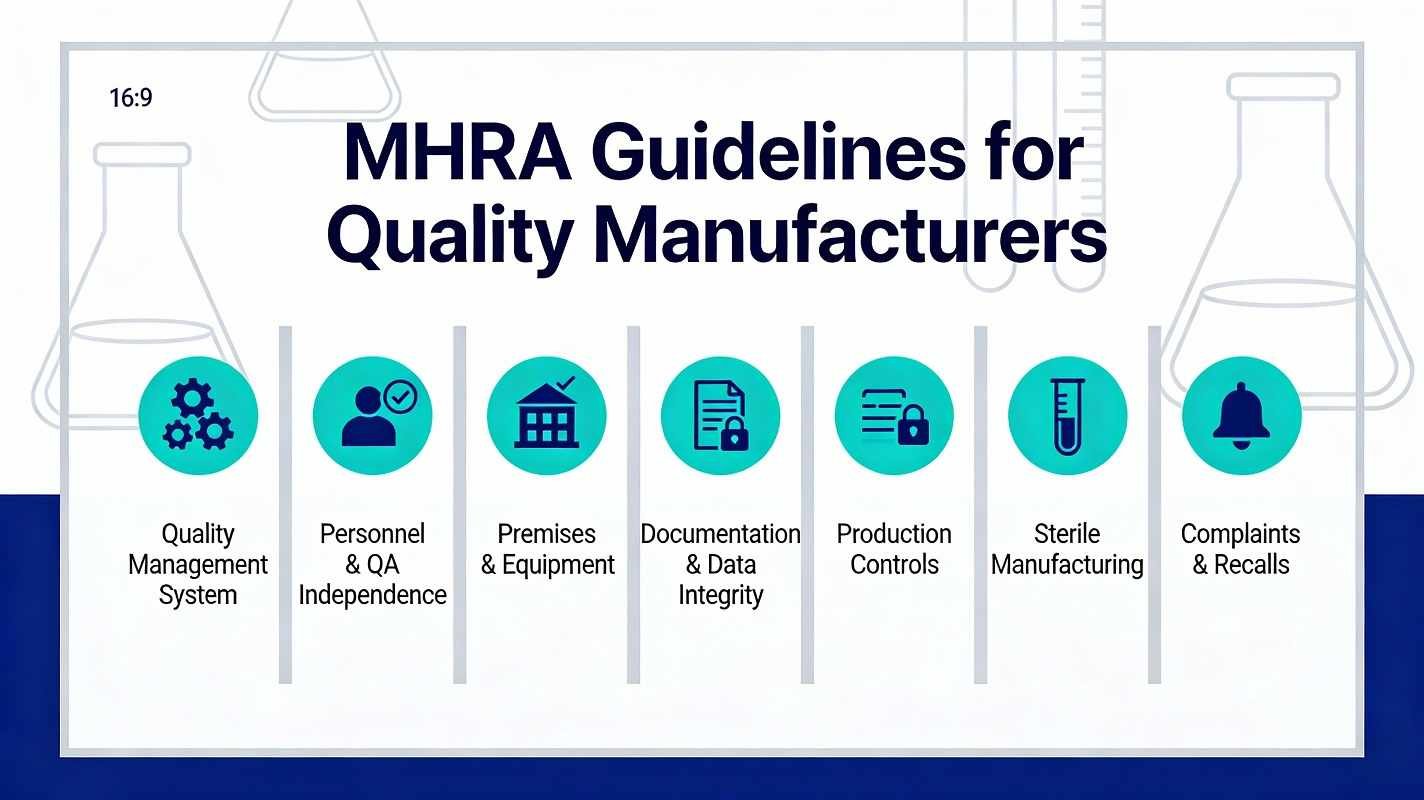

MHRA guidelines for the pharmaceutical industry are the UK’s Good Manufacturing Practice and Good Distribution Practice rules, consolidated by the Medicines and Healthcare products Regulatory Agency in Rules and Guidance for Pharmaceutical Manufacturers and Distributors — the “Orange Guide”, currently the 2022 eleventh edition — and given legal force by the Human Medicines Regulations 2012.[1][2] The MHRA is a member of PIC/S and applies the PIC/S GMP guide (PE 009), so the technical expectations track EU GMP closely.[3]
For an Indian manufacturer, the single most important point is this: India is not on the UK’s approved country for import list or the approved country for batch testing list. Product made in India and sold in Great Britain must therefore be imported by a holder of a UK Manufacturer’s Licence (MIA), re-tested on importation, and certified batch-by-batch by a UK Qualified Person before release — not simply checked by a wholesaler’s Responsible Person (import).[4][5]
This guide is written for Indian formulation and API plants that want UK business, and for QA and regulatory teams who need to know exactly what the MHRA guidelines require of them. It was rebuilt on 19 August 2026, after the India–UK Comprehensive Economic and Trade Agreement entered into force on 15 July 2026.[6]
What the MHRA guidelines actually consist of
There is no single document called “the MHRA guidelines”. The obligations sit in four layers, and knowing which layer a requirement comes from tells you how negotiable it is.
Statute — the binding layer
The Human Medicines Regulations 2012 (SI 2012/1916) is the operative UK law for human medicines. It creates the Marketing Authorisation, the Manufacturer’s Licence (MIA), the Wholesale Dealer’s Licence (WDA(H)), the Qualified Person, and — post-Brexit — the Responsible Person (import) register at regulation 45AB.[2][5] Schedule 7 sets the batch-control duties a QP cannot delegate away.[4]
Everything below this layer is guidance. Guidance can be departed from with justification; the Regulations cannot.
The nine GMP chapters
Reproduced in the Orange Guide and functionally aligned with EU GMP Part I and PIC/S PE 009:[1][3]
- Ch. 1 Pharmaceutical Quality System — product quality review, quality risk management, management review. Historically the most-cited chapter in MHRA deficiency data.[7]
- Ch. 2 Personnel — an independent quality unit, defined key personnel, training records that prove competence rather than attendance.
- Ch. 3 Premises and Equipment — segregation, cross-contamination prevention, qualification status visible at the equipment.
- Ch. 4 Documentation — the chapter that carries the data-integrity expectation for both paper and electronic records.
- Ch. 5 Production — starting-material controls, supplier qualification, and the prevention of cross-contamination through a documented strategy.
- Ch. 6 Quality Control — sampling, specifications, out-of-specification handling, reference and retention samples, ongoing stability.
- Ch. 7 Outsourced Activities — the written technical agreement, which is where third-party and loan-licence arrangements are audited.
- Ch. 8 Complaints and Recall — recall effectiveness testing, and reporting quality defects to the MHRA.
- Ch. 9 Self-Inspection — a real internal audit programme with CAPA closure, not a one-page annual form.
The annexes that decide inspections
- Annex 1 — sterile products. The revised text, applicable since August 2023, requires a documented Contamination Control Strategy, ISO 14644 classification, media fills and container closure integrity.
- Annex 11 — computerised systems. Persistently in the MHRA’s top-ten cited areas, and the technical home of audit trails and access control.[7]
- Annex 15 — qualification and validation. DQ/IQ/OQ/PQ, process validation, and cleaning validation. Cleaning validation is expected to be justified against health-based exposure limits (HBELs) rather than the old 1/1000th-dose and 10 ppm conventions alone.
- Annex 16 — QP certification and batch release. The annex that governs what a UK QP must satisfy themselves of before releasing an Indian-made batch, including sampling and testing on importation.[8][9]
- Annex 21 — importation of medicinal products. Sets the importer’s obligations where the manufacturing site sits outside the territory.[10]
Things that exist only in the UK
- Approved country for import list and approved country for batch testing list — the mechanism that lets EEA-certified batches into Great Britain without re-testing. India is on neither list.[4][11]
- Responsible Person (import), RPi — a statutory register at regulation 45AB, requiring a life-science degree, membership of a listed professional body, and at least two years performing Responsible Person functions. Applies only to imports from listed countries.[5]
- International Recognition Procedure (IRP) — operational since 1 January 2024, allowing the MHRA to rely on an approval already granted by one of seven reference regulators.[12]
- Compliance escalation and the Compliance Monitor — the MHRA’s route for a site that repeatedly fails to close findings, short of licence action.[13]
Where to get the official documents, free
A large share of the search traffic for “MHRA guidelines PDF” ends at paid or scraped copies. The primary sources below are free and authoritative; the printed Orange Guide is the only item that is a commercial publication.
| Document | What it covers | Where |
|---|---|---|
| Human Medicines Regulations 2012 | The binding UK law — licences, QP, RPi, batch controls | legislation.gov.uk |
| MHRA GMP and GDP guidance hub | Inspection process, deficiency grading, licence applications | gov.uk |
| Import a human medicine | Which licence you need, and when a QP must certify | gov.uk |
| Approved countries lists | Batch testing and importation recognition | gov.uk |
| MHRA Inspectorate blog | Inspector commentary — Annex 16 FAQs, Single Inspection Program | mhrainspectorate.blog.gov.uk |
| Orange Guide 2022 (11th ed.) | The consolidated GMP/GDP reference — a priced book | Pharmaceutical Press, ISBN 9780857114396 |
Scroll the table sideways on a phone. Note: “MHRA Orange Book” is a common mis-search — the Orange Book is the US FDA’s approved-drug list. The UK equivalent reference is the Orange Guide.
The UK import chain for an India-made medicine
This is the part most export guides get wrong, and it changes your costing. Because India is not a listed country, the EEA short-cut does not apply. The chain is:
- STAGE 01UK Marketing AuthorisationHeld by a UK-established entity. Your Indian site is named on the MA as a manufacturing site.
- STAGE 02Importer holds an MIAA Manufacturer’s Licence covering import — a WDA(H) alone is not sufficient for a non-listed country.[11]
- STAGE 03Testing on importationFull qualitative and quantitative analysis of at least the active substance(s), repeated in the UK, because there is no UK–India batch-testing arrangement.[4][8]
- STAGE 04UK QP certificationA QP named on the MIA certifies each batch under Annex 16 before it can be placed on the market.[8]
- STAGE 05Wholesale distributionOnward supply under a WDA(H) with a named Responsible Person, to GDP standards.
Correction to a widely repeated claim. Many India-focused articles — including an earlier version of this page — state that Indian consignments enter Great Britain under a WDA(H) verified by a Responsible Person (import). That is the mechanism for medicines arriving from countries on the approved import list, which currently means the EEA.[5][11] For India, plan and price for an MIA holder, import testing and UK QP certification instead. Getting this wrong understates the landed cost and the partner you need.
Why this is commercially useful, not just technical. Import testing is a recurring per-batch cost carried by your UK partner, and it is negotiable in the supply agreement. Sites whose analytical data package is clean enough for a UK QP to lean on — validated methods transferred to the importer’s laboratory, comparative analysis of India-drawn versus UK-drawn samples — can build the case, over time, to rely on reduced testing under a documented scientific justification.[9] That case is built from analytical discipline, not from correspondence.
Which route applies to you?
Select what you make and where you stand with a UK partner. The tool names the licence that governs your route and the first control point to fix.
1. What do you supply?
2. Do you have a UK partner in place?
Select an option above
Your route determines every document you will need, so decide it before spending on anything else.
What MHRA inspectors actually look for
MHRA regulation is principles-based and risk-managed rather than a checklist. The agency’s most recent published GMP inspection deficiency dataset covers 2019 inspections, and the pattern in it has been stable for a decade: quality system failures under Chapter 1 dominate, with Annex 11 computerised systems, Annex 15 validation and Annex 1 sterility assurance close behind.[7]
| Area | What is examined | The failure that gets cited |
|---|---|---|
| Quality system (Ch. 1) | Product quality review, risk management applied to change control and deviations, management review with evidence of decisions | A PQS that exists on paper but does not drive any decision |
| Data integrity (Ch. 4, Annex 11) | Individual logins, audit trails that cannot be disabled, raw analytical data that cannot be quietly deleted or reprocessed, ALCOA+ across paper and electronic records[14] | Shared chromatography logins and unreviewed audit trails |
| CAPA effectiveness | Deviation to root cause to action to verified effectiveness | The same deviation recurring after closure |
| Validation (Annex 15) | Process validation with process knowledge, cleaning validation justified against HBELs, computerised system validation | Cleaning limits with no toxicological basis |
| Utilities and water | Purified water and WFI system qualification, sanitisation, alert and action limits, trending of bioburden and endotoxin, distribution loop design | Trending that records results without acting on drift |
| Supplier qualification (Ch. 5, Ch. 7) | Audits of critical suppliers, written quality agreements, risk-based re-audit intervals | Reliance on the supplier’s certificate of analysis alone |
| Sterile (Annex 1) | Contamination control strategy, ISO 14644 classification, media fills, environmental monitoring history, container closure integrity | A CCS assembled for the inspection rather than lived |
Scroll sideways for the full table. The same disciplines are what Revised Schedule M now demands domestically — which is why a Schedule M upgrade and a UK export ambition are best planned as one project. For the underlying data-integrity standard, see our guide to ALCOA and ALCOA+ principles.
Compliance escalation and the Compliance Monitor
Where a site does not close findings adequately, the MHRA does not jump straight to licence action. It operates a graduated compliance escalation process, including a Compliance Monitor — an independent, MHRA-approved person appointed at the company’s cost to verify remediation and report back to the inspectorate.[13] For an overseas site, escalation is expensive and slow, and it stalls supply while it runs. The cheaper path is a CAPA response that is complete and verifiable the first time.
MHRA compared with USFDA, EU-GMP and WHO-GMP
Most Indian exporters already hold WHO-GMP and are choosing where the next increment of capital goes. This is how the UK route compares.
| Dimension | UK — MHRA | US — USFDA | EU-GMP / WHO-GMP |
|---|---|---|---|
| GMP basis | Orange Guide 2022 (11th ed.) plus PIC/S PE 009 | 21 CFR 210/211 cGMP | EU GMP Parts I and II; WHO TRS annexes |
| Market entry document | UK Marketing Authorisation (national route or IRP) | ANDA or NDA | EU or national MA; CoPP for WHO-route tenders |
| Site verification | MHRA inspection, or reliance where an arrangement exists | Pre-approval and routine FDA inspection | EU or national inspection; WHO-GMP via state licensing authority and CDSCO |
| Batch release for India-made product | Import testing plus UK QP certification under Annex 16 | US agent; release per the approved application | EU QP certification with import testing per Annex 16 |
| Reliance route available | Yes — IRP, if the product is already approved by a reference regulator | No general reliance route | Limited; MRAs with specified countries only |
| Best suited to | UK-specific supply, now with CETA tariff advantage | US generics at volume | Broad export and institutional tenders |
Before committing capital, our pharma plant setup cost calculator prices the same configuration across Revised Schedule M, WHO-GMP, EU-GMP and USFDA. If you are weighing an acquisition instead of a build, see the pharma plants available for sale.
Can an Indian company use the International Recognition Procedure?
Not directly, because India is not one of the MHRA’s reference regulators — those are the EMA and EU member state authorities, the US FDA, Health Canada, Swissmedic, Japan’s PMDA, Australia’s TGA and Singapore’s HSA.[12] But the IRP is keyed to the product, not the applicant’s nationality. If your molecule already holds an FDA or EMA approval in which your site is named, your UK partner can use that approval as the reference under IRP Recognition A or B. For an Indian company already pursuing the USFDA route, this makes UK entry materially cheaper as a second market rather than a separate project.
What CETA changed on 15 July 2026
The India–UK Comprehensive Economic and Trade Agreement was signed on 24 July 2025 and entered into force on 15 July 2026, alongside the Double Contribution Convention.[6] For a pharmaceutical exporter, three things matter and one does not.
- Tariffs. The UK removed duties on 99% of Indian tariff lines at entry into force, including duties of up to 8% on chemicals and pharmaceuticals.[6]
- Rules of origin. Preference is not automatic. You must be able to support an origin claim with a valid proof of origin under the agreement’s product-specific rules — a documentation burden that falls on your commercial and dispatch teams, not QA.[15]
- Mobility. Structured business-visitor and intra-corporate-transfer categories make it easier to send QA staff to a UK partner’s site for method transfer and audit response.[16]
- What did not change: CETA is a trade agreement, not a mutual recognition agreement on GMP or batch testing. It does not put India on the approved country for batch testing list, does not waive import testing, and does not create a shortcut to a UK Marketing Authorisation. Anyone selling CETA as regulatory relief is overselling it.
Where inspection burden may genuinely fall. Since February 2024 the MHRA, Health Canada and Australia’s TGA have been piloting a GMP Single Inspection Program for foreign manufacturing sites of common interest, with each authority covering the other’s scope where possible.[17] This is a real reliance mechanism and worth tracking — but it remains a pilot with a small number of inspections completed, so build your plan on passing an MHRA inspection, and treat the SIP as upside rather than as a strategy.
A realistic sequence to first compliant shipment
The timeline below is a practitioner’s estimate from Indian sites that have made this transition, not a published MHRA figure. Sites already holding EU-GMP move considerably faster because the technical work is largely done.
- STEP 01Fix the route and the moleculesFinished dose, API or contract manufacture, and which specific products. Register with Pharmexcil and hold a valid IEC from DGFT.
- STEP 02Close the GMP gapA documented gap assessment against the Orange Guide and PIC/S PE 009. Prioritise Chapter 1, data integrity and validation — the areas that dominate findings.
- STEP 03Build the analytical caseValidated methods capable of transfer to a UK laboratory, stability to ICH conditions, and a data package a UK QP can defend at inspection.
- STEP 04Secure the UK partnerAn MA holder and an MIA holder able to import and certify, plus a written technical and quality agreement before the first production batch.
- STEP 05Pass the inspectionPrepare for an MHRA GMP inspection of your site. A complete, verifiable CAPA response is part of passing, not a follow-up.
- STEP 06Ship, release, sustainFirst consignment moves with your CoPP and batch evidence; import testing and QP certification happen in the UK. Then hold the standard — audit readiness is continuous.
If your first UK order is likely to come as third-party work for a brand owner, the commercial mechanics are set out in our third-party manufacturing and loan licence pages — the quality bar in both cases is the partner’s MA and the MHRA’s expectations, not the Indian domestic minimum.
Frequently asked questions
They are the UK’s Good Manufacturing Practice and Good Distribution Practice requirements, consolidated by the MHRA in Rules and Guidance for Pharmaceutical Manufacturers and Distributors — the Orange Guide, currently the 2022 eleventh edition — and given legal force by the Human Medicines Regulations 2012. The technical content comprises nine GMP chapters and a set of annexes, closely aligned with EU GMP and the PIC/S guide PE 009, plus UK-specific material on licensing, inspection and importation.
No. The Orange Guide is published commercially by Pharmaceutical Press and there is no free official PDF; copies offered as free downloads are unauthorised and usually out of date. However, almost all of its substance is available free from primary sources: the Human Medicines Regulations 2012 on legislation.gov.uk, the MHRA GMP and GDP guidance collection on gov.uk, and the EU GMP chapters and annexes the UK guide reproduces. For an Indian QA team, those free sources are sufficient for gap assessment work.
To supply a finished medicine in Great Britain the product needs a UK Marketing Authorisation held by a UK-established entity, and your site must be named on it and satisfy MHRA GMP expectations, normally verified by inspection. For bulk API you do not need a product MA, but the UK or EU formulator buying from you will require a robust Drug Master File, and where relevant a Certificate of Suitability from the EDQM, and will audit your GMP status before ordering. EU clearance does not automatically grant UK access.
No, and this is a common misunderstanding. The Responsible Person (import) mechanism applies where a licensed medicine arrives in Great Britain from a country on the approved country for import list, which currently means the EEA. India is not on that list, so a product made in India requires import under a Manufacturer’s Licence, testing on importation, and certification by a UK Qualified Person under Annex 16 before it can be placed on the market. Plan your partner and your landed cost around that route.
WHO-GMP is a sound foundation and puts you on aligned quality principles, but on its own it does not grant UK market access for a finished medicine. You still need the UK Marketing Authorisation route, a site that will withstand an MHRA inspection, and batch documentation an importing QP can rely on. Treat WHO-GMP as the platform the UK-specific steps are built on, not the finish line — the practical gap is usually data integrity, validation depth and analytical method robustness rather than the building itself.
It reduces cost, not regulatory burden. CETA entered into force on 15 July 2026 and removed UK duties on 99% of Indian tariff lines, including chemicals and pharmaceuticals. It is not a mutual recognition agreement on GMP or batch testing: it does not place India on the approved country for batch testing list, does not waive testing on importation, and does not shorten the route to a UK Marketing Authorisation. The commercial case improves; the compliance work is unchanged.
Water is treated as a critical utility under GMP Chapter 3 and, for sterile products, Annex 1. Expect scrutiny of design and qualification of the generation and distribution loop, sanitisation regime and its validation, sampling plans covering every user point over a defined qualification period, alert and action limits with documented scientific basis, and trending that demonstrably triggers action when results drift. Cold-stored WFI and alternative WFI generation methods are permitted where qualified. Records must satisfy the same ALCOA+ expectations as laboratory data.
For a finished-dose product supplied under a UK Marketing Authorisation, yes — the MHRA inspects overseas manufacturing sites named on an MA, on a risk basis. Since February 2024 the MHRA, Health Canada and the TGA have piloted a Single Inspection Program for foreign sites of common interest, which may in time reduce duplicate inspections, but it remains a pilot. Prepare on the assumption that an MHRA inspection will happen, with data integrity and the quality system as the first two areas to harden.
Planning UK supply? Close the gap before the first order, not after a rejected batch.
Route selection, GMP gap assessment against Orange Guide and PIC/S expectations, analytical and batch-documentation review, and partner requirements — from 23+ years in pharmaceutical QA, QC and drug regulatory affairs.
References
- Medicines and Healthcare products Regulatory Agency. Rules and Guidance for Pharmaceutical Manufacturers and Distributors 2022 (The Orange Guide). 11th ed. London: Pharmaceutical Press; 2022. ISBN 9780857114396.
- The Human Medicines Regulations 2012, SI 2012/1916. United Kingdom. Available from: https://www.legislation.gov.uk/uksi/2012/1916/contents. Accessed August 2026.
- Pharmaceutical Inspection Co-operation Scheme. PIC/S Guide to Good Manufacturing Practice for Medicinal Products, PE 009. Geneva: PIC/S. Available from: https://picscheme.org/en/publications. Accessed August 2026.
- The Human Medicines Regulations 2012, Schedule 7, paragraph 14 (approved country for batch testing list). Available from: https://www.legislation.gov.uk/uksi/2012/1916/schedule/7. Accessed August 2026.
- The Human Medicines Regulations 2012, regulations 45AA and 45AB (responsible person (import) and register). Available from: https://www.legislation.gov.uk/uksi/2012/1916/regulation/45AB. Accessed August 2026.
- Press Information Bureau, Government of India. India and the United Kingdom: Comprehensive Economic and Trade Agreement and Double Contribution Convention to enter into force on 15 July 2026. New Delhi: PIB; 2026. Available from: https://www.pib.gov.in. Accessed August 2026.
- Medicines and Healthcare products Regulatory Agency. Good manufacturing practice inspection deficiencies (official statistics, 2019 inspection dataset). Available from: https://www.gov.uk/government/statistics/good-manufacturing-practice-inspection-deficiencies. Accessed August 2026.
- European Commission. EudraLex Volume 4, Annex 16: Certification by a Qualified Person and Batch Release. Brussels: European Commission; 2015. Reproduced in the MHRA Orange Guide.
- MHRA Inspectorate. Annex 16 QP certification and batch release: frequently asked questions, part 1. 23 February 2017. Available from: https://mhrainspectorate.blog.gov.uk/2017/02/23/annex-16-qp-certification-and-batch-release-frequently-asked-questions-part-1/. Accessed August 2026.
- European Commission. EudraLex Volume 4, Annex 21: Importation of Medicinal Products. C(2022) 843 final. Brussels: European Commission; 2022.
- Medicines and Healthcare products Regulatory Agency. Import a human medicine; and List of approved countries for authorised human medicines. GOV.UK. Available from: https://www.gov.uk/guidance/import-a-human-medicine. Accessed August 2026.
- Medicines and Healthcare products Regulatory Agency. International Recognition Procedure. GOV.UK; operational from 1 January 2024. Available from: https://www.gov.uk/government/publications/international-recognition-procedure. Accessed August 2026.
- MHRA Inspectorate. Compliance Monitor process, part 1: an introduction. 11 March 2022. Available from: https://mhrainspectorate.blog.gov.uk/2022/03/11/compliance-monitor-process-part-1-an-introduction/. Accessed August 2026.
- Medicines and Healthcare products Regulatory Agency. GXP Data Integrity Guidance and Definitions, revision 1. London: MHRA; March 2018.
- HM Revenue and Customs. India Free Trade Agreement: proofs of origin and origin declarations. UK Integrated Online Tariff; 13 July 2026. Available from: https://www.trade-tariff.service.gov.uk. Accessed August 2026.
- House of Commons Library. UK–India Free Trade Agreement. Research Briefing CBP-10258. London: UK Parliament; 2026. Available from: https://commonslibrary.parliament.uk/research-briefings/cbp-10258/. Accessed August 2026.
- Jackson I. Pilot GMP Single Inspection Program. MHRA Inspectorate blog, 20 February 2024. Available from: https://mhrainspectorate.blog.gov.uk/2024/02/20/15076/. Accessed August 2026.
Disclaimer. This article is technical and educational content for pharmaceutical professionals. It is not legal, regulatory, medical or investment advice, and it does not replace the MHRA Orange Guide, the Human Medicines Regulations 2012, the relevant GMP annexes, or engagement of a qualified regulatory professional. UK medicines law, the approved-country lists and India–UK trade arrangements change; verify against the current GOV.UK and legislation.gov.uk texts before making compliance or investment decisions. Reviewed 19 August 2026 by Darshan Singh.
Does an Indian manufacturer need MHRA approval to export medicines to the UK?
To supply a finished medicine to the UK market, the product needs a UK Marketing Authorisation and your site must satisfy MHRA GMP expectations — verified through an MHRA inspection or recognised GMP evidence. For bulk APIs, you do not need a product MA, but the UK or EU formulator buying from you will require a robust Drug Master File and will verify your GMP status. In every case the UK operates its own rules post-Brexit, so EU clearance does not automatically grant UK access.
What is the difference between MHRA and EU-GMP for an Indian plant?
The quality expectations are closely aligned — the UK’s Orange Guide is a modified version of EU GMP, and both the MHRA and EU apply PIC/S standards. The differences are in market-access paperwork: the UK requires its own Marketing Authorisation, its own batch-import verification through the Responsible Person (import), and, where required, an MHRA inspection of your site. A plant built to EU-GMP has done most of the technical work already; what remains is the UK-specific documentation and partner setup.
What is the difference between MHRA and EU-GMP for an Indian plant?
The quality expectations are closely aligned — the UK’s Orange Guide is a modified version of EU GMP, and both the MHRA and EU apply PIC/S standards. The differences are in market-access paperwork: the UK requires its own Marketing Authorisation, its own batch-import verification through the Responsible Person (import), and, where required, an MHRA inspection of your site. A plant built to EU-GMP has done most of the technical work already; what remains is the UK-specific documentation and partner setup.
What is a Responsible Person (import) and do I need one in India?
The RPi is a UK role, held by your UK importer, not by you. It is the named person who confirms that a batch was properly certified before it entered the UK. You do not appoint an RPi in India, but you must supply the clean, traceable batch documentation — Certificate of Analysis, batch records, CoPP and full traceability — that allows the importer’s RPi to do their job. Weak batch documentation is a common reason Indian consignments stall at UK entry.
Reference:
- Medicines and Healthcare products Regulatory Agency (MHRA). (2022). Rules and Guidance for Pharmaceutical Manufacturers and Distributors (The Orange Guide). UK Government Publishing Service.
- MHRA. (2024). Grading of inspection findings: Good manufacturing practice and good distribution practice. Retrieved from https://www.gov.uk/guidance/good-manufacturing-practice-and-good-distribution-practice
- MHRA. (2021). Guidance for ‘specials’ manufacturers. UK Government Publications. Retrieved from https://www.gov.uk/government/publications/guidance-for-specials-manufacturers/guidance-for-specials-manufacturers
- MHRA. (2021). The supply of unlicensed medicinal products (“specials”): Guidance on the interpretation of section 104 of the Human Medicines Regulations 2012. GN1 Guidance Note.
- MHRA. (2018). GXP Data Integrity Guidance and Definitions. MHRA Inspectorate. Retrieved from https://assets.publishing.service.gov.uk/media/5aa2b9ede5274a3e391e37f3/MHRA_GxP_data_integrity_guide_March_edited_Final.pdf
- MHRA. (2016). Data Integrity Definitions and Guidance for Industry. MHRA Publications. (Withdrawn; superseded by 2018 guidance)
- MHRA Inspectorate. (2016). Handling of Unexpected Deviations. MHRA Inspectorate Blog. Retrieved from https://mhrainspectorate.blog.gov.uk/2016/06/17/handling-of-unexpected-deviations/
- MHRA Inspectorate. (2022). Compliance Monitor Process (Part 1): An Introduction. MHRA Inspectorate Blog. Retrieved from https://mhrainspectorate.blog.gov.uk/2022/03/11/compliance-monitor-process-part-1-an-introduction/
- MHRA. (2016). GDP Inspection Deficiency Data 2016. MHRA Statistical Analysis. Retrieved from https://assets.publishing.service.gov.uk/media/5a81e1c440f0b62302699ab8/GDP_2016_Deficiency_data.pdf
- MHRA. (2024). GMP in the UK: 2025 Guide. Regulatory Affairs Guidance.
- European Commission. (2022). Annex 1: Manufacture of Sterile Medicinal Products. EU Guidelines to Good Manufacturing Practice (PIC/S Revision). Retrieved from https://health.ec.europa.eu/system/files/2022-08/20220825_gmp-an1_en_0.pdf
- European Commission. (2015). Annex 15: Qualification and Validation. EU Guidelines to Good Manufacturing Practice. Retrieved from https://health.ec.europa.eu/document/download/7c6c5b3c-4902-46ea-b7ab-7608682fb68d_en?filename=2015-10_annex15.pdf
- European Commission. (2015). Annex 15: Qualification and Validation (Alternative source). Retrieved from https://health.ec.europa.eu/system/files/2016-11/2015-10_annex15_0.pdf
- European Commission. (2022). Certification by a Qualified Person and Batch Release (Annex 16). EU Guidelines to Good Manufacturing Practice. Retrieved from https://health.ec.europa.eu/document/download/0d97da0d-ea5d-4920-a0d0-5dd1e99070ac_en?filename=gmpbr_200001_en.pdf
- WHO. (2015). Annex 2: WHO Guidelines on Quality Risk Management. Technical Report Series 981. Retrieved from https://www.who.int/docs/default-source/medicines/norms-and-standards/guidelines/production/trs981-annex2-who-quality-risk-management.pdf
- PIC/S. (2023). PE 009-13 PIC/S Guide to Good Manufacturing Practice for Medicinal Products. Pharmaceutical Inspection Co-operation Scheme.
- ISPE. (2022). GAMP 5: A Risk-Based Approach to Compliant GxP Computerized Systems (2nd Edition). International Society for Pharmaceutical Engineering.
- Scilife Regulatory. (2025). GAMP 5 for GxP Compliant Computerized Systems. Retrieved from https://www.scilife.io/blog/gamp5-for-gxp-compliant-computerized-systems
- Simplerqms. (2025). Supplier Qualification: Definition, Process, and Guidelines. Retrieved from https://simplerqms.com/supplier-qualification/
- GMP Compliance. (2021). The GMP Requirements for Supplier Qualification. Retrieved from https://www.gmp-compliance.org/gmp-news/the-gmp-requirements-for-supplier-qualification
- Biopharma International. (2022). Qualification of Raw Materials for Biopharmaceutical Use. Retrieved from https://www.biopharminternational.com/view/qualification-raw-materials-biopharmaceutical-use
- Scilife Regulatory. (2025). MHRA Inspection Preparation Guide: What to Expect and How to Prepare. Retrieved from https://www.scilife.io/blog/mhra-inspection-preparation-guide
- Pharma GMP. (2024). An Overview of MHRA GMP Requirements for Pharmaceutical Manufacturers. Retrieved from https://www.pharmagmp.in/an-overview-of-mhra-gmp-requirements-for-pharmaceutical-manufacturers/
- Pharma GMP. (2024). Understanding UK MHRA GMP Inspection Model. Retrieved from https://www.pharmagmp.in/understanding-uk-mhra-gmp-inspection-model/
- Pharma Regulatory. (2025). Linking Deviation Trends to Regulatory Inspection Risk. Retrieved from https://www.pharmaregulatory.in/linking-deviation-trends-to-regulatory-inspection-risk/
- Pharmaceutical Online. (2019). Top MHRA GMP Inspection Deficiencies by Annex/Chapter in 2019. Retrieved from https://www.pharmaceuticalonline.com/doc/top-most-cited-mhra-gmp-inspection-deficiencies-by-annex-chapter-in-0001
- Pharmaceutical Press. (2024). The MHRA Orange Guide (2022 Edition Overview). Retrieved from https://www.pharmaceuticalpress.com/products/the-mhra-orange-guide/
- Makrocare. (2023). MHRA Adverse Incident Reporting: Criteria & Procedures. Retrieved from https://www.makrocare.com/blog/adverse-event-reporting-in-uk-samd/
- PubMed Central / NCBI. (2010). Medical Device Vigilance Systems: India, US, UK, and Australia. Journal of Pharmaceutical and Biomedical Analysis. Retrieved from https://pmc.ncbi.nlm.nih.gov/articles/PMC3417867/
- RPC Legal. (2017). Medical Device Concerns and MHRA Compliance. Retrieved from https://www.rpclegal.com/thinking/medical-and-life-sciences/medical-device-concerns-and-mhra-compliance/
- Qualityze. (2025). QMS Guidelines for Pharmaceutical Industry. Retrieved from https://www.qualityze.com/blogs/qms-guidelines-pharmaceutical-industry
- Russell Regulatory Consultants. (2025). The Importance of Quality Management Systems for UK Medical Devices. Retrieved from https://www.russellregulatoryconsultants.com/2025/06/05/the-importance-of-quality-management-systems-for-uk-medical-devices/
- Pharmaguideline. (2018). MHRA Guidelines. Retrieved from https://www.pharmaguideline.com/2010/10/mhra.html
- Pharma GMP. (2024). Understanding Annex 15: Qualification and Validation. Retrieved from https://www.pharmagmp.in/understanding-annex-15-qualification-and-validation/
- Project Manager Template. (2025). Pharmaceutical Change Control: Quality and Compliance. Retrieved from https://www.projectmanagertemplate.com/post/pharmaceutical-change-control-quality-and-compliance
- Pharma Regulatory. (2025). Role of Qualified Person (QP) in ATMP Batch Certification. Retrieved from https://www.pharmaregulatory.in/role-of-qualified-person-qp-in-atmp-batch-certification/
- NHS Specialised Pharmacy Service. (2022). Labelling & Packaging of Unlicensed Medicines (Specials). Retrieved from https://www.sps.nhs.uk/wp-content/uploads/2022/03/Guidance-Pharmacy-Specials-FINAL-for-publication.pdf
- GERPAC. (2015). MHRA Guidance for Specials Manufacturers. European Pharmacy Cooperation. Retrieved from https://www.gerpac.net/platform/pluginfile.php/441/mod_resource/content/1/Guidance_for__specials__manufacturers%20-%20Jan%2015%202015.pdf