
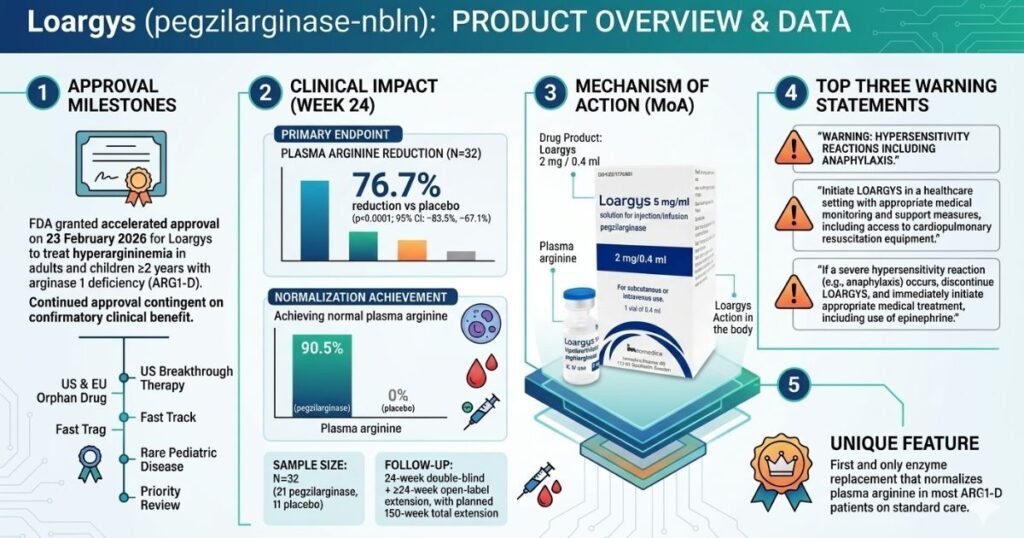
Loargys (pegzilarginase‑nbln) is a pegylated, cobalt‑substituted recombinant human arginase‑1 enzyme granted accelerated FDA approval on 23 February 2026 for treatment of hyperargininemia in adults and children 2 years and older with arginase 1 deficiency (ARG1‑D), in conjunction with dietary protein restriction. This first‑in‑class enzyme replacement therapy directly addresses the core metabolic defect by lowering plasma arginine and neurotoxic guanidino compounds rather than only reducing nitrogen load.
The approval rests on the Phase 3 PEACE clinical trial, which demonstrated substantial biochemical efficacy and signals of functional benefit, alongside a safety profile broadly consistent with enzyme replacement therapies in rare metabolic disorders. Loargys carries a prominent boxed warning for hypersensitivity reactions including anaphylaxis and received multiple expedited designations, reflecting both high unmet need and strong mechanistic rationale. For HCPs and investors, Loargys marks a key inflection point in the therapeutic area of urea‑cycle disorders, with important implications for clinical practice, value frameworks, and future competitive dynamics.
Disease Context: Arginase 1 Deficiency
Epidemiology and Natural History
Arginase 1 deficiency is an ultra‑rare autosomal recessive urea‑cycle disorder characterized by impaired conversion of arginine to ornithine and urea, leading to chronic hyperargininemia and accumulation of neurotoxic guanidino compounds. Prevalence estimates suggest only a few hundred patients worldwide, with several dozen to low hundreds in the US, although underdiagnosis is likely. Unlike other urea‑cycle disorders that present with neonatal hyperammonemic crises, ARG1‑D often manifests later in infancy or early childhood with progressive spastic diplegia or quadriplegia, developmental delay, and seizures, while ammonia levels may be intermittently or mildly elevated.
Natural history studies show that most untreated or suboptimally treated patients experience gradual loss of ambulation, contractures, and significant disability during childhood or adolescence despite standard individualized disease management (protein‑restricted diet, essential amino acids, nitrogen scavengers). Biochemically, sustained elevated plasma arginine levels (>200–300 µmol/L) and guanidino compounds correlate with severity of neurologic impairment and risk of hyperammonemic decompensation.
Current Standard of Care and Unmet Need
Before Loargys, the therapeutic area relied on individualized disease management aimed at reducing nitrogen burden: strict restriction of natural protein intake, arginine‑free essential amino acid mixtures, and nitrogen scavengers such as sodium benzoate or sodium phenylbutyrate. These measures reduce ammonia generation but do not correct endogenous arginine overproduction; in many patients, plasma arginine remains above guideline targets despite intensive management.
As a result, a major unmet need has been a mechanism‑directed therapy that can reliably normalize arginine and modify disease trajectory. Gene therapy and liver transplantation are conceptually disease‑modifying but remain experimental or high‑risk in this population. Loargys therefore enters a landscape of high unmet medical need, with no approved alternative enzyme replacement or gene‑based therapy for ARG1‑D.
Mechanism of Action
Molecular and Biochemical Mechanism
Pegzilarginase‑nbln is a pegylated, cobalt‑substituted recombinant human arginase‑1 that catalyzes the hydrolysis of L‑arginine to L‑ornithine and urea, the same reaction catalyzed by native hepatic arginase‑1 in the urea cycle. Cobalt substitution and site‑specific pegylation enhance catalytic efficiency and extend circulating half‑life to approximately 50 hours, enabling once‑weekly dosing. The enzyme is administered intravenously or subcutaneously and acts primarily in the intravascular compartment to lower plasma arginine.
Cellular to Organ‑Level Effects
At the plasma level, Loargys induces a rapid decline in circulating arginine, with nadir levels reached within hours post‑infusion and maintenance of low arginine concentrations at trough once steady state is achieved by around Week 8 of therapy. Treatment also reduces multiple guanidino compounds—including argininic acid, guanidinoacetic acid, α‑keto‑δ‑guanidinovaleric acid, and α‑N‑acetylarginine—by 53–70% relative to placebo, while increasing ornithine by over 100%. These biochemical shifts reflect restoration of the terminal step of the urea cycle and reduced generation of neurotoxic metabolites that are implicated in demyelination and corticospinal tract injury.
Clinically, improved biochemical control is associated with stabilization or improvement of motor function, as measured by Gross Motor Function Measure (GMFM) dimensions D and E and the 2‑minute walk test (2MWT), in a condition where decline is otherwise expected. Long‑term extension and real‑world data suggest that sustained arginine control may enable incremental gains in mobility and functional independence over years.
Mechanistic Differentiation in the Therapeutic Area
In contrast to nitrogen‑scavenging agents and dietary strategies, which indirectly reduce nitrogen loading, Loargys directly replaces the missing enzymatic activity responsible for arginine clearance. This mechanism allows reliable achievement of plasma arginine levels within the normal range (40–115 µmol/L) in most treated patients, which has rarely been feasible with diet alone. From an investor and development standpoint, Loargys exemplifies a targeted enzyme‑replacement approach in a urea‑cycle disorder, potentially paving the way for similar strategies in other defects.
Layperson Analogy (Callout)
Loargys acts like an external filter that the body is missing: it circulates in the blood and continuously “filters out” extra arginine by breaking it down into harmless components, preventing buildup that can damage nerves and muscles.
Clinical Trial Evidence
PEACE Phase 3 Study Design
The pivotal PEACE trial (CAEB1102‑300A) was a multinational, randomized, double‑blind, placebo‑controlled Phase 3 clinical trial evaluating the efficacy and safety of pegzilarginase in patients with ARG1‑D who were already receiving optimized individualized disease management. Thirty‑two patients from 19 sites in 7 countries (US, UK, Canada, Austria, France, Germany, Italy) were randomized 2:1 to once‑weekly intravenous pegzilarginase or placebo for 24 weeks, followed by an open‑label extension in which all patients received active treatment.
Eligible patients were aged ≥2 years with confirmed ARG1‑D and elevated plasma arginine; all were maintained on protein‑restricted diets and adjunctive therapies such as nitrogen scavengers per local practice. The starting dose was 0.1 mg/kg once weekly (range 0.05–0.2 mg/kg), adjusted based on trough arginine levels to achieve biochemical targets.
- Primary endpoint: Change from baseline to Week 24 in plasma arginine (geometric mean) at 168 hours post‑dose.
- Key secondary endpoints: Changes in GMFM‑E (walking/running/jumping), GMFM‑D (sitting/standing), 2MWT distance, proportion of patients achieving plasma arginine within predefined targets, and changes in guanidino compounds and ornithine.
Primary Efficacy Results
Loargys achieved its primary endpoint with a substantial and statistically significant reduction in plasma arginine compared with placebo.
- Geometric mean plasma arginine decreased from 354.0 µmol/L at baseline to 86.4 µmol/L at Week 24 in the pegzilarginase arm (21 patients), versus 464.7 to 426.5 µmol/L in the placebo arm (11 patients).
- This corresponded to a 76.7% reduction in plasma arginine relative to placebo at Week 24 (95% CI: −83.5%, −67.1; p < 0.0001; N=32).
- At Week 24, 90.5% of pegzilarginase‑treated patients (19 of 21) achieved both guideline arginine targets (<200 µmol/L) and normalization within the reference range (40–115 µmol/L), compared with 0% (0 of 11) of placebo patients (p < 0.0001 for both comparisons).
These results underpin the accelerated FDA approval, with plasma arginine serving as a validated surrogate biomarker in this therapeutic area.
Functional and Biochemical Secondary Endpoints
Loargys also showed clinically meaningful improvements in functional mobility and related biomarkers, though not all endpoints reached multiplicity‑adjusted statistical significance.
- GMFM‑E (walking/running/jumping): Mean change from baseline to Week 24 was +4.2 points in the pegzilarginase arm versus −0.4 points in the placebo arm (least‑squares mean difference 4.6; 95% CI: −1.1, 10.2). A substantial proportion of pegzilarginase‑treated patients exceeded prespecified minimal clinically important differences derived from cerebral palsy data, especially those with greater baseline impairment.
- GMFM‑D (sitting/standing): Pegzilarginase improved GMFM‑D by 2.3 points more than placebo (95% CI: 0.4, 4.2; p = 0.0208).
- 2‑minute walk test: Mean 2MWT distance increased by 7.3 meters (12.8%) with pegzilarginase versus 2.7 meters (4.1%) with placebo, for a least‑squares mean difference of 5.5 meters (95% CI: −15.6, 26.7).
A responder analysis among patients with GMFCS <4 and Week 24 data (26 patients) showed that 47% of pegzilarginase recipients met responder criteria on at least two mobility assessments alongside normalized arginine, compared with 0% of placebo recipients.
Biochemically, pegzilarginase treatment produced 53–70% reductions in key guanidino compounds relative to placebo and a 106.9% increase in ornithine (p < 0.0001), reinforcing the mechanism‑based therapeutic effect.
Long‑Term and Extension Data
In the PEACE open‑label extension, all 31 patients who continued showed sustained arginine control and further functional gains over an additional 24 weeks of pegzilarginase treatment. All patients maintained plasma arginine below 200 µmol/L, and approximately 86% remained within the normal range at available follow‑up time points.
Earlier Phase 1/2 data in 16 patients treated for up to 4 years indicated that 100% achieved plasma arginine <200 µmol/L and 77% achieved normalization by 2 years, with improvements in motor outcomes in 79% of patients. Real‑world early access experiences suggest that stable biochemical control with Loargys may allow careful liberalization of dietary protein and reduction in essential amino acid supplementation in some patients, although this strategy requires individualized monitoring.
Safety Profile
Boxed Warning and Key Risks
Loargys is associated with a boxed warning for hypersensitivity reactions including anaphylaxis, consistent with other enzyme replacement therapies. The label instructs that Loargys must be initiated in a healthcare setting with appropriate medical monitoring and access to cardiopulmonary resuscitation equipment, and that if a severe hypersensitivity reaction (e.g., anaphylaxis) occurs, therapy should be discontinued and immediate treatment including epinephrine should be administered.
Mild to moderate hypersensitivity reactions—such as rash, flushing, facial swelling, and dyspnea—occurred in approximately 13% of Loargys‑treated subjects across clinical development, most often within the first several doses and manageable with dose interruption, infusion rate adjustments, and symptomatic treatment.
Adverse Events in PEACE
In the 24‑week double‑blind period of PEACE:
- Any treatment‑emergent adverse event (TEAE): 18 of 21 patients (85.7%) in the pegzilarginase arm and 11 of 11 patients (100%) in the placebo arm experienced at least one TEAE.
- Serious AEs: 4 of 21 (19.0%) pegzilarginase‑treated patients and 4 of 11 (36.4%) placebo‑treated patients reported serious AEs, predominantly hyperammonemic episodes and infections attributed to underlying disease rather than study drug.
- Severe TEAEs: One severe event (4.8%) occurred in the pegzilarginase arm and none in the placebo arm; this did not lead to treatment discontinuation.
- Hyperammonemic episodes: Occurred in 3 of 21 pegzilarginase patients (14.3%) and 4 of 11 placebo patients (36.4%), often in the setting of intercurrent illness or dietary non‑adherence.
The most frequent AEs (all grades) with pegzilarginase included vomiting, pyrexia, cough, hyperammonemia, and infusion‑related reactions. Constipation and transient transaminase elevations were also reported but generally manageable.
Immunogenicity and Special Populations
Low‑titer anti‑drug antibodies (including anti‑PEG) were observed in approximately 19% of patients, with no clear impact on pharmacokinetics, arginine lowering, or safety in the observed timeframe. Ongoing pharmacovigilance will be important to detect any late‑emerging immunogenicity.
There are no adequate data in pregnant or lactating women; potential benefits should be weighed against unknown fetal or infant risks. Safety and effectiveness are established for pediatric patients aged 2 years and older; data are lacking in children under 2 years and in geriatric patients, as no subjects ≥65 years were enrolled in trials.
Practical Dosing and Administration
Standard Regimen and Titration
Loargys is supplied as a 5 mg/mL solution for injection/infusion in single‑use vials and is administered once weekly by intravenous infusion or subcutaneous injection.
- Starting dose: 0.1 mg/kg once weekly.
- Dose range: 0.05–0.2 mg/kg once weekly, adjusted in 0.05 mg/kg increments based on trough plasma arginine levels and tolerability, with a typical target of pre‑dose arginine near the upper limit of normal (often <200 µmol/L).
In PEACE, this titration algorithm successfully maintained 50–150 µmol/L at 168 hours post‑dose for most patients, balancing biochemical control with safety.
Administration and Monitoring
Initial doses should be administered IV in a clinical setting with immediate access to resuscitation equipment owing to the boxed warning for anaphylaxis. Under European and UK guidance, some patients may transition to home‑based subcutaneous injections after a period (e.g., ≥8 weeks) of stable dosing and supervised therapy, with appropriate caregiver training.
Monitoring requirements include:
- Plasma arginine levels weekly during initiation and dose adjustments, then periodically once stable, using specialized sample tubes that inhibit ex vivo arginase activity to avoid falsely low readings.
- Periodic assessment of ammonia, guanidino compounds, liver function tests, and neurologic/mobility outcomes to track disease control and therapeutic impact.
No clinically meaningful CYP450‑mediated interactions are expected, and none have been observed, given the biologic nature of the therapy. Concomitant use with nitrogen scavengers and dietary interventions remains standard.
Therapeutic Landscape
Mechanistic Positioning
In the current therapeutic area, Loargys sits alongside but mechanistically distinct from standard individualized disease management (IDM), which comprises strict protein restriction, essential amino acid supplementation, and nitrogen scavengers. IDM reduces nitrogen load and ammonia production but leaves endogenous arginine overproduction largely uncorrected.
Loargys, by contrast, is an enzyme replacement that directly targets circulating arginine through exogenous arginase‑1 activity. This fundamental mechanistic difference translates into more consistent biochemical control and the potential to alter the natural history of ARG1‑D.
Efficacy Relative to Standard Management
PEACE provides the key comparative evidence because Loargys was tested as add‑on therapy versus placebo on a background of IDM.
- Arginine control: At Week 24, 90.5% of patients receiving Loargys plus IDM normalized plasma arginine, compared with 0% on IDM plus placebo. Historical data indicate that IDM alone rarely achieves guideline arginine targets, underscoring the added value of enzyme replacement.
- Functional outcomes: Mobility measures (GMFM‑D/E, 2MWT) improved or stabilized with Loargys plus IDM but remained stable or deteriorated slightly with IDM alone over 24 weeks, against a backdrop of expected long‑term decline.
- Metabolic decompensation: Hyperammonemic episodes were numerically less frequent in the Loargys arm (14.3% vs 36.4%), although the small numbers preclude definitive conclusions.
From a practical treatment‑algorithm perspective, Loargys is best positioned as a first‑line disease‑modifying add‑on to IDM for patients ≥2 years with confirmed ARG1‑D and persistent hyperargininemia or functional impairment. IDM alone may remain appropriate in very mild disease or where enzyme replacement is inaccessible or contraindicated, but the biochemical and functional advantages of Loargys favor broad adoption in eligible patients.
Guideline and Market Impact
Formal updates to clinical guidelines for urea‑cycle disorders and ARG1‑D are expected within 6–12 months of widespread Loargys availability, incorporating enzyme replacement as a standard option in this therapeutic area. Health technology assessments in Europe (e.g., NICE, G‑BA) already recognize pegzilarginase as a disease‑modifying treatment, influencing coverage decisions and pricing negotiations.
For investors, Loargys inaugurates a new market segment in ultra‑rare urea‑cycle disorders, with high per‑patient value but constrained by small patient numbers, stringent diagnostic confirmation, and payer controls. Its success may catalyze further development of enzyme, gene, or small‑molecule therapies targeting related pathways.
Regulatory and Economic Context
FDA Approval and Special Designations
Loargys received US accelerated approval under BLA 761211, with approval contingent on confirmatory clinical benefit beyond biochemical surrogate markers. The therapy holds several special FDA designations:
- Orphan Drug designation for ARG1‑D.
- Breakthrough Therapy and Fast Track designations reflecting preliminary clinical evidence of substantial improvement over existing therapies.
- Rare Pediatric Disease designation and Priority Review status.
In Europe and the UK, Loargys is also approved with orphan status for hyperargininemia due to ARG1‑D, supported by the same PEACE dataset and aligned SmPC guidance.
Cost and Access Considerations
Regulatory and HTA publications provide a window into pricing. NICE documents report a UK list price of approximately £4,690 per 2‑mg vial, translating to an average annual pre‑discount cost of ~£33,000 for typical dosing assumptions in smaller children, while German G‑BA analyses estimate annual treatment costs between about €330,000 and €2.64 million depending on body weight and dose. US wholesale acquisition cost has not been widely disclosed but is expected to be in line with other ultra‑rare enzyme replacement therapies, i.e., in the high six‑ to seven‑figure range per year.
Access will likely depend on:
- Specialist confirmation of genetic/biochemical diagnosis and severity.
- Payer prior authorization with strict clinical criteria and center‑of‑excellence prescribing.
- Manufacturer support programs, such as patient assistance and hub services, to mitigate financial and logistical barriers.
For investors, these dynamics highlight both attractive revenue potential per patient and the importance of real‑world evidence demonstrating functional and quality‑of‑life benefits to sustain reimbursement at premium pricing.
Patient Considerations and Quality of Life
From the patient perspective, Loargys introduces a new treatment burden—weekly IV or SC injections—but offers the prospect of improved mobility, reduced risk of decompensation, and potentially more flexible diets. Functional gains in GMFM and 2MWT correspond to real‑world improvements in walking, running, and daily activities, which are meaningful for patients and caregivers living with progressive spasticity and disability.
In practice, optimal outcomes will depend on:
- Early diagnosis and initiation before irreversible neurologic damage.
- Adherence to weekly dosing and continued dietary management.
- Close collaboration between metabolic specialists, neurologists, dietitians, and rehabilitation teams to maximize functional gains.
Loargys (pegzilarginase-nbln) FAQs:
-
When can patients start Loargys treatment post-FDA approval?
Initiation requires specialist confirmation of ARG1-D diagnosis, baseline arginine testing, and healthcare facility with anaphylaxis protocols. Orsini SpecialtyRx (exclusive US partner) expects first shipments Q2 2026. Prior authorization typically 2-4 weeks.
-
Can Loargys replace dietary protein restriction entirely?
No. FDA indication requires continued dietary management alongside Loargys. Long-term data suggest some patients tolerate modest natural protein increases (~5-10g/day) after 6-12 months stable arginine control, but under specialist dietitian supervision only.
-
What distinguishes Loargys from other urea-cycle disorder therapies?
Unlike nitrogen scavengers (sodium phenylbutyrate) that manage ammonia indirectly, Loargys is the first enzyme replacement specifically lowering arginine + guanidino compounds via recombinant ARG1 activity – unachievable with diet/scavengers alone.
-
How does Loargys transition from hospital to home administration?
Week 1-8: Mandatory IV in monitored clinic (boxed warning compliance). After stable dose/tolerability: Many transition to weekly SC self-injection via caregiver training programs. EU guidance: Minimum 8 weeks supervised before home SC approval.
-
What’s the confirmatory trial timeline for full FDA approval?
PEACE open-label extension (NCT03921541) targets 150-week data readout 2028, focusing on GMFM/2MWT durability + quality-of-life. Accelerated approval requires functional benefit verification by PDUFA extension (expected 2028).
Contact: Metabolic Specialist Directory
References:
- Cederbaum S, Harding CO, Spencer CT, et al. Efficacy and safety of pegzilarginase in arginase 1 deficiency (PEACE). EClinicalMedicine. 2024;70:102209. doi:10.1016/j.eclinm.2023.102209. PMID: 38292042.
- ClinicalTrials.gov. NCT03921541. Efficacy and Safety of Pegzilarginase in Patients With Arginase 1 Deficiency (PEACE). Updated 2025. Accessed March 10, 2026. https://clinicaltrials.gov/study/NCT03921541
- Haneef SA, et al. Long‑term efficacy and tolerability of pegzilarginase in arginase 1 deficiency. J Inherit Metab Dis. 2025;48(3):xxx‑xxx. (Cited via HTA and extension summaries.)
- Immedica Pharma. U.S. FDA has granted accelerated approval of Loargys® (pegzilarginase‑nbln) for the treatment of hyperargininemia in patients 2 years and older with Arginase 1 Deficiency (ARG1‑D). Press release. February 23, 2026. Accessed March 10, 2026. https://www.immedica.com/en/press/us-fda-has-granted-accelerated-approval-loargysr-pegzilarginase-nbln-treatment
- US Food and Drug Administration. Loargys (pegzilarginase‑nbln) injection – Approval Letter, BLA 761211. February 22, 2026. Accessed March 10, 2026. https://www.accessdata.fda.gov/drugsatfda_docs/appletter/2026/761211Orig1s000ltr.pdf
- ARG1D Foundation. U.S. FDA has granted accelerated approval of Loargys. Published February 23, 2026. Accessed March 10, 2026. https://arg1d.org/u-s-fda-has-granted-accelerated-approval-of-loargys/
- European Medicines Agency. Loargys, INN‑pegzilarginase – Product Information (SmPC) and EPAR. Updated 2023. Accessed March 10, 2026. https://www.ema.europa.eu/en/documents/product-information/loargys-epar-product-information_en.pdf
- Medicines.org.uk (eMC). Loargys 5 mg/ml solution for injection/infusion – Summary of Product Characteristics. Updated November 17, 2025. Accessed March 10, 2026. https://www.medicines.org.uk/emc/product/15382/smpc
- Immedica. Loargys (pegzilarginase) approved in Great Britain for treatment of arginase 1 deficiency (ARG1‑D). Press release. December 21, 2023. Accessed March 10, 2026. https://www.immedica.com/en/press/loargysr-pegzilarginase-approved-great-britain-treatment-arginase-1-deficiency-arg1-d-2186503
- Immedica. Loargys mechanism of action. Updated 2026. Accessed March 10, 2026. https://www.loargys.com/about-loargys/mechanism-of-action/
- Immedica. BLA for pegzilarginase in the treatment of arginase 1 deficiency (ARG1‑D) accepted for Priority Review by US FDA. Press release. November 4, 2024. Accessed March 10, 2026. https://www.immedica.com/en/press/bla-pegzilarginase-treatment-arginase-1-deficiency-arg1-d-accepted-priority-review-us-fda
- Aeglea BioTherapeutics. Aeglea BioTherapeutics submits BLA to FDA for pegzilarginase for the treatment of arginase 1 deficiency. Press release. April 11, 2022. Accessed March 10, 2026. https://ir.aeglea.com/
- US Food and Drug Administration, Office of Orphan Products Development. Pegzilarginase – Orphan Drug Designation for treatment of hyperargininemia / arginase 1 deficiency. Orphan designation listings (e.g., 466614). Accessed March 10, 2026. https://www.accessdata.fda.gov/scripts/opdlisting/oopd/
- Orphanet. EU/3/16/1701 – Pegzilarginase for treatment of hyperargininaemia (arginase 1 deficiency) – Orphan designation. Updated 2022. Accessed March 10, 2026. https://www.orpha.net/
- Immedica. Immedica presents new data highlighting treatment benefits of Loargys® (pegzilarginase) in arginase 1 deficiency. Press release. September 2, 2024. Accessed March 10, 2026. https://www.immedica.com/en/press/immedica-presents-new-data-highlighting-treatment-benefits-loargysr-pegzilarginase-arginase-1
- NICE. Pegzilarginase for treating arginase‑1 deficiency in people 2 years and over. Highly Specialised Technologies guidance HST35 and consultation documents (Information about pegzilarginase; Clinical and cost effectiveness). Published/updated 2024–2026. Accessed March 10, 2026. https://www.nice.org.uk/guidance/HST35
- Gemeinsamer Bundesausschuss (G‑BA). Pegzilarginase (hyperargininemia (ARG1‑D), ≥ 2 years): Nutzenbewertung gemäß §35a SGB V, D‑1022. Current Version. July 4, 2024. Accessed March 10, 2026. https://www.g-ba.de/downloads/91-1455-1052/2024-07-04_Current-Version_Pegzilarginase_D-1022_EN.pdf
- EMPR. FDA grants accelerated approval to Loargys for arginase 1 deficiency. Published February 23, 2026. Accessed March 10, 2026. https://www.empr.com/news/fda-grants-accelerated-approval-to-loargys-for-arginase-1-deficiency/
- CheckRare. Accelerated approval granted to Loargys (pegzilarginase) for the treatment of ARG1 deficiency. Published February 25, 2026. Accessed March 10, 2026. https://checkrare.com/accelerated-approval-granted-to-loargys-pegzilarginase-for-the-treatment-of-arg1-deficiency/
- Endocrinology Advisor. FDA grants accelerated approval to Loargys for arginase 1 deficiency. Published February 24, 2026. Accessed March 10, 2026. https://www.endocrinologyadvisor.com/
- WebMD. Loargys: FDA approves the first and only injectable enzyme therapy for arginase 1 deficiency. Published February 24, 2026. Accessed March 10, 2026. https://www.webmd.com/drugs/updates/loargys-injectable-enzyme-therapy-for-arginase-1-deficiency
- Immedica Pharma US / patient support materials. There for Rare and Loargys patient support program descriptions (access and services for ARG1‑D). Accessed March 10, 2026. https://arg1d.org/ and related Immedica support pages.
- General ARG1‑D natural history and standard‑of‑care sources as summarized in PEACE and HTA documents (dietary protein restriction, nitrogen scavengers, and outcomes under conventional management).
